
The short answer
Start with an overall spending limit and the tasks you carry out in a normal week. Eliminate cars that do not meet your parking, passenger and load requirements, then compare versions and prices for a small number of candidates.
Who this guide is for
For people planning to buy a car who find it difficult to narrow a wide choice to a list they can examine seriously.

A good shortlist is not a collection of the most talked-about cars within your budget. It contains a few candidates that meet your practical requirements, leave financial headroom and can be compared as specific versions. Start with your week's journeys and overall spending limit, and only then turn to model names.
A car can meet almost every requirement and still fail at something you do twice a day: fitting into a parking space, accommodating a passenger who struggles to bend down or carrying work equipment. Once you define those tasks in advance, narrowing the choice becomes easier. Even an enticing offer faces a clear test that does not depend on how excited you feel in the showroom.
Build a budget that still works after delivery
Divide the money into three parts: purchase, running costs and a reserve. For the purchase, include the final price, fees and incidental costs listed in the offer. For running costs, include insurance, energy, maintenance, parking and finance where applicable. The reserve is there to prevent every small change from requiring another loan.
There is no magic percentage of income here. Write down what you can spend without postponing other commitments, then assess the car against that amount. If the budget covers only the deposit, you have not yet defined a car budget. The running-cost breakdown will help distinguish a payment leaving your account this month from a cost accumulating over the years.
For finance, ask for figures covering the same amount and term. The Bank of Israel's loan comparison tool shows differences between offers in the market, but does not replace a personalised offer. Do not conclude that one car is cheaper because its quoted repayment is lower: the deposit, term or final payment may differ.
If part of your purchase budget relies on a loan, add an estimated monthly repayment based on your offer and also read the interest and balloon payment terms before adding running costs.
Describe a normal week and two unusual days
List journeys to work, passenger trips, shopping and visits. Beside each journey, note who travels, what equipment comes along and where the car is parked. Do not try to invent a precise annual average if you lack the data. A well-documented week is more useful than a plausible-sounding number unrelated to your life.
Alongside the normal week, write down two less frequent but important scenarios: a long family journey, or a day when all the equipment needs to travel together. You can now distinguish between a need the car itself must meet and one that can be addressed another way. Your decision does not have to be the same in both cases.
Also consider expected changes with a firm basis, such as a job move that has already been arranged. There is little point in buying a much larger car for a remote possibility, but a known, imminent change should not be ignored. Your usage routine is a working document; you can update it, and it is worth understanding what has changed before replacing your shortlist.
You can turn the routes you listed into fuel costs for your routine, provided you consistently define whether each trip is one-way or a return journey.
Separate essential requirements from preferences
An essential requirement is something without which the car is unsuitable: the number of seats, fitting a parking space or carrying particular equipment. A preference is something you want and can weigh against the price. Do not give the two categories equal weight. A large screen does not make up for insufficient space for a child seat.
| Question | How to check it | What counts as a satisfactory answer |
|---|---|---|
| Does the car fit the parking space? | Measure the space and the access route | There is also room to open doors and get in and out |
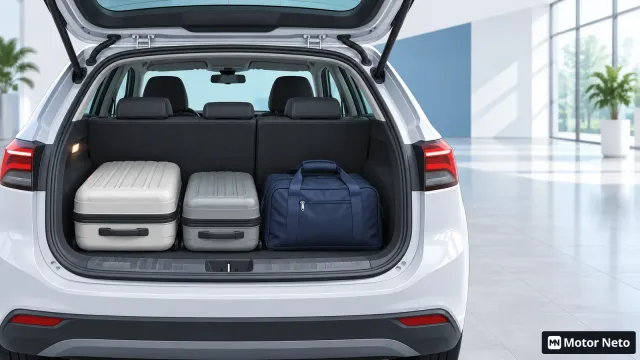
| Does the load fit? | Bring the actual items | They can be loaded without an improvised solution |
| Can all passengers manage comfortably? | Sit in the car together | Seating and access suit the intended use |
| Is the powertrain suitable? | Record journeys and charging access | There is an everyday solution and a fallback |
Does the car fit the parking space?
- How to check it
- Measure the space and the access route
- What counts as a satisfactory answer
- There is also room to open doors and get in and out
Does the load fit?
- How to check it
- Bring the actual items
- What counts as a satisfactory answer
- They can be loaded without an improvised solution
Can all passengers manage comfortably?
- How to check it
- Sit in the car together
- What counts as a satisfactory answer
- Seating and access suit the intended use
Is the powertrain suitable?
- How to check it
- Record journeys and charging access
- What counts as a satisfactory answer
- There is an everyday solution and a fallback
The table is not a car ranking. It is a framework for questions that specifications alone cannot answer. Boot capacity, for example, does not describe the shape of the opening or how your pushchair fits through it. Exterior length alone does not tell you how easy it will be to get out of the car in a narrow parking space either.
Choose the powertrain only after checking the infrastructure
If you are considering a plug-in vehicle, write down where it will charge on a normal day and who controls access to the charger. Parking beside a charging point is not a promise that it will be available to you. Workplace charging can suit a particular routine very well, but it is important to know what happens during holidays or a change of employment.
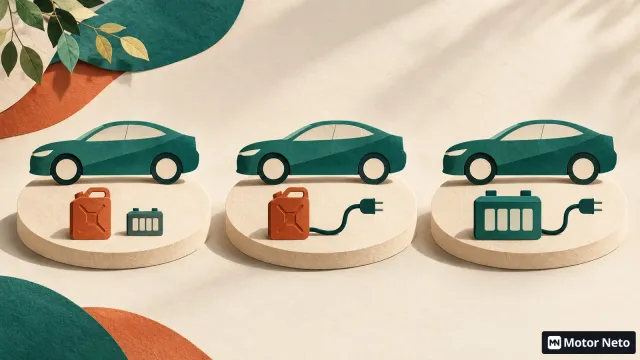
A conventional hybrid, plug-in hybrid and fully electric car are not three levels of the same product. Their energy sources and dependence on charging differ. The guide to choosing between powertrains explains how to assess them without copying a consumption figure from a scenario unlike your own.
Do not reject an option in advance simply because of a rule you heard from a friend, or accept it solely because of a claimed range. Check a regular route, a long route and a backup plan. If there is no practical answer for one of them, it is an unresolved issue to settle before the car joins the shortlist.
Compare versions you can actually order
A model name is not a specification. Your list should include the trim level (רמת גימור), powertrain, dated offer and included equipment. Official websites may contain pages from different periods at the same time. Toyota's importer brochures, for example, illustrate why it is worth consulting the model document rather than relying on a picture on the home page.
Ask each seller for a total price for the car you intend to receive, including a delivery date and payment terms. An extra-cost colour, a locally fitted accessory or a different version can change the comparison. If a detail is not confirmed, mark it as missing rather than assuming every car with the same name has that equipment.
Narrow the list to a number you can examine seriously. Three candidates are a convenient starting point, not a binding rule. If only two meet the essential requirements, there is no need to add a third simply to fill a table. If none meets them, explicitly change the budget or requirements rather than making the gap disappear.
If two people drive the car, ask each to rank their needs separately before discussing them together. A difference in preferences is not a defect in the list: it is information that needs to be resolved. You can agree in advance who uses the car more and in which situations, avoiding the assumption that one driver's comfort represents both of you.
Give the test drive a job to do
Bring the other drivers and the important equipment. Ask to check the tasks you perform every day: getting in, adjusting the seat, visibility, operating the climate controls and loading. During an arranged drive, pay attention to the points you identified and write down your impressions immediately afterwards. Your own subjective experience is perfectly legitimate information for your decision.
Ask which version was used for the demonstration. If it is not the version being offered, record which differences may affect your impressions. Do not assume that every wheel, seat or system you saw will be fitted to the car you order. Return to the written offer and update only the items for which you have an answer.
Checklist before you continue
Once the shortlist is ready, the choice does not have to be mathematical. You can choose the car you like more, provided you already understand the compromises you are making and what they cost.
Useful tools for this topic
- Fuel cost calculator for journeys, monthly spending and sharing costsCalculate litres and costs per journey, month and year, including cost per km and an equal split between those paying.
- Car loan calculator: monthly repayments, interest and balloon paymentCalculate monthly repayments, total interest and payments from the loan terms you enter, with or without a final balloon payment.
Found an error or outdated information? Read how we handle corrections and sources, or email us: [email protected].