
The short answer
A conventional hybrid needs no external charging, a plug-in hybrid combines charging and fuel, and a fully electric car depends on charging. Choose according to your weekly use, access to chargers and the total cost of the versions you are comparing.
Who this guide is for
For car buyers who want to understand which powertrain suits their infrastructure and journeys.
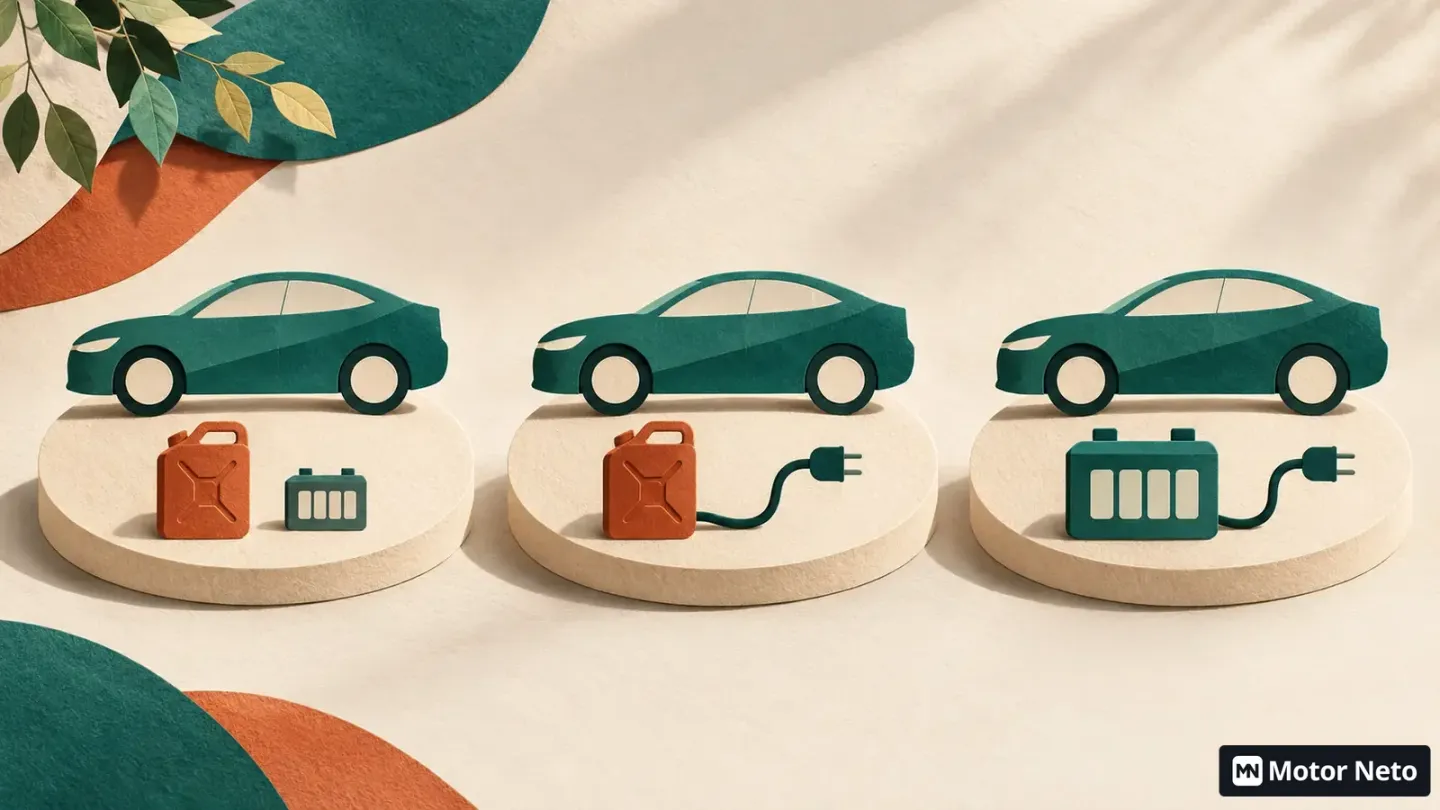
The right powertrain depends on your driving routine, charging access and total cost. A conventional hybrid does not need to connect to a charger, a plug-in hybrid allows electric driving alongside a combustion engine, and a fully electric car relies on external charging. The practical difference is what you will need to do each week to use the car comfortably.
Before looking at the lowest consumption figure, ask under what conditions it was obtained. A plug-in car tested with a charged battery may not reflect your use if you have no regular place to charge. An electric car's quoted range is also no substitute for planning the long route you actually drive.
Three names, three questions about energy
In a conventional hybrid, a combustion engine and an electrical system work together, and the battery is not intended to be charged from an external socket. A plug-in hybrid also offers an external connection and a battery that enables electric use according to the model's capabilities. A fully electric car uses electric propulsion and has no combustion engine to provide backup on the road.
The US government's Alternative Fuels Data Center, AFDC, defines the technological differences between these types. Those definitions help explain their design, but vehicle prices, tariffs or ranges should not be copied from there into the Israeli market. Take each candidate's figures from its local specification.
Pay attention to the term mild hybrid too. It does not promise the same capabilities as a full hybrid system. Instead of relying on the word attached to the car, ask what the system can do and which energy source is needed in normal use. You do not need to turn the choice into an engineering lesson to obtain a clear answer.
If you have no regular charging access, start with that reality
A conventional hybrid may suit someone who wants familiar refuelling without managing a routine of plugging into a charger. That does not guarantee every model will be more economical than every alternative or justify any purchase-price premium. You still need to check consumption, use, insurance and the total price for the particular model.
A plug-in hybrid can also run on fuel, but buying one without a charging plan means checking how much of its electric advantage you will actually use. Ask what its fuel consumption is when the battery is not providing the electric portion of the journey, under the relevant test conditions. A low weighted figure is not a substitute for that answer.
An electric car without home charging is not necessarily impossible. It requires an assessment of chargers, prices and time, as explained in the guide to an EV without private charging. Before deciding whether it suits you, map out a week's use and a backup plan rather than relying on a blanket rule.
Daily driving and long journeys are different tests
Write down your routine journey distances and the intervals between charging opportunities. In a plug-in hybrid, how often you connect it is central to how many journeys you can make on electricity. On longer trips, you need to understand what happens once the energy available for electric driving runs low.
For a fully electric car, check a long route with compatible chargers and alternatives. For a conventional hybrid, check fuel consumption and the car's suitability for the road, without assuming an urban figure describes other journeys too. Every powertrain needs scrutiny; the questions are simply different.
| Pattern of use | Main question | What you should not assume |
|---|---|---|
| Short journeys with charging available | How much electric driving can you incorporate? | That every plug-in model is equally suitable |
| No regular connection | What recurring energy solution will you use? | That a nearby charger is always free |
| Frequent long journeys | What happens over the entire route? | That laboratory range or consumption is guaranteed |
| A car shared by several drivers | Who charges it, and when? | That one driver's routine represents everyone's |
Short journeys with charging available
- Main question
- How much electric driving can you incorporate?
- What you should not assume
- That every plug-in model is equally suitable
No regular connection
- Main question
- What recurring energy solution will you use?
- What you should not assume
- That a nearby charger is always free
Frequent long journeys
- Main question
- What happens over the entire route?
- What you should not assume
- That laboratory range or consumption is guaranteed
A car shared by several drivers
- Main question
- Who charges it, and when?
- What you should not assume
- That one driver's routine represents everyone's
The table does not decide the issue on the strength of one label. It identifies the question to resolve first. Once you have an answer, you can compare actual cars rather than three abstract technologies assigned advantages and disadvantages without reference to their price and size.
Read consumption figures in the same language
Check whether the figure is litres per 100 km, kWh per 100 km or another weighted measure. Record the test cycle too, such as WLTP, and the version to which it applies. You cannot sensibly compare two numbers simply because both are small when each measures something different.
For a plug-in car, include both electricity and fuel in your usage scenario. If you calculate only the litres, electricity costs disappear from the table. If you assume every journey is electric without a charging plan, the result relies on a condition that may not be met.
Separate a manufacturer's figure from a budget scenario. You can use several consumption assumptions for comparison, but you need to label them as assumptions. A figure gathered on a short drive may help with your own use, but it is not a measurement test that establishes what every driver will achieve over a year.
For the petrol component, you can use the calculator that accepts two fuel-consumption units, but for a plug-in car you must calculate electricity separately as well.
Cost also includes buying and owning the car
Compare the full purchase price, finance terms, insurance, maintenance and energy expenses. If charging infrastructure is needed, clarify the cost and feasibility of installing it before ordering, through suitable professionals. This guide does not provide installation instructions, and a commercial agreement for a car is not authorisation for electrical work at home.
A plug-in hybrid also has a combustion engine, so read the maintenance schedule for the entire system. In an electric car, the absence of that engine does not mean there is no maintenance. Instead of copying a general claim about savings, ask for a service schedule and quotes for the work that will fall within your ownership period.
Read the battery warranty terms separately. The warranty period, mileage limit and capacity threshold, if there is one, are not necessarily the same across powertrain types or models. A long warranty on one component does not automatically extend the same cover to the entire car.
Where home charging is possible, you can compare electricity and petrol expenses for the same mileage and separately add the car's price, the infrastructure and the other ownership expenses to the result.
Choose candidates, then check them in real life
Once you understand which energy solution suits you, narrow the list to cars with clear local prices and specifications. Compare seating, luggage capacity, parking and operation too. A powertrain cannot make up for a car that does not suit the people who need to use it every day.
On a test drive, ask what operating state the car is in and which version you have been shown. Your personal impressions are a legitimate part of your choice, but they cannot replace the documents. If an important detail is missing from the offer, ask for it to be confirmed before ordering.
You can start by building a shortlist around your budget and routine and return to it after clarifying the powertrain choice. Your decision does not have to favour the newest technology. It needs to fit what you can and want to do with the car over time.
Checklist before you continue
The right choice is one that the next driver in the family can explain too: where to replenish energy, what it takes, and what to do on a less typical day.
Useful tools for this topic
- Fuel cost calculator for journeys, monthly spending and sharing costsCalculate litres and costs per journey, month and year, including cost per km and an equal split between those paying.
- Home EV charging cost calculator and petrol comparisonEstimate the electricity cost of your driving using a domestic tariff and charging losses, and compare it with petrol spending.
Found an error or outdated information? Read how we handle corrections and sources, or email us: [email protected].