
The short answer
You can consider an electric car without a home charger if you have a regular charging option and a practical backup. Calculate energy, parking and time costs together, and check access and compatibility at the times you will use the charger.
Who this guide is for
For people without a parking space with charging who are considering relying on their workplace or public chargers.
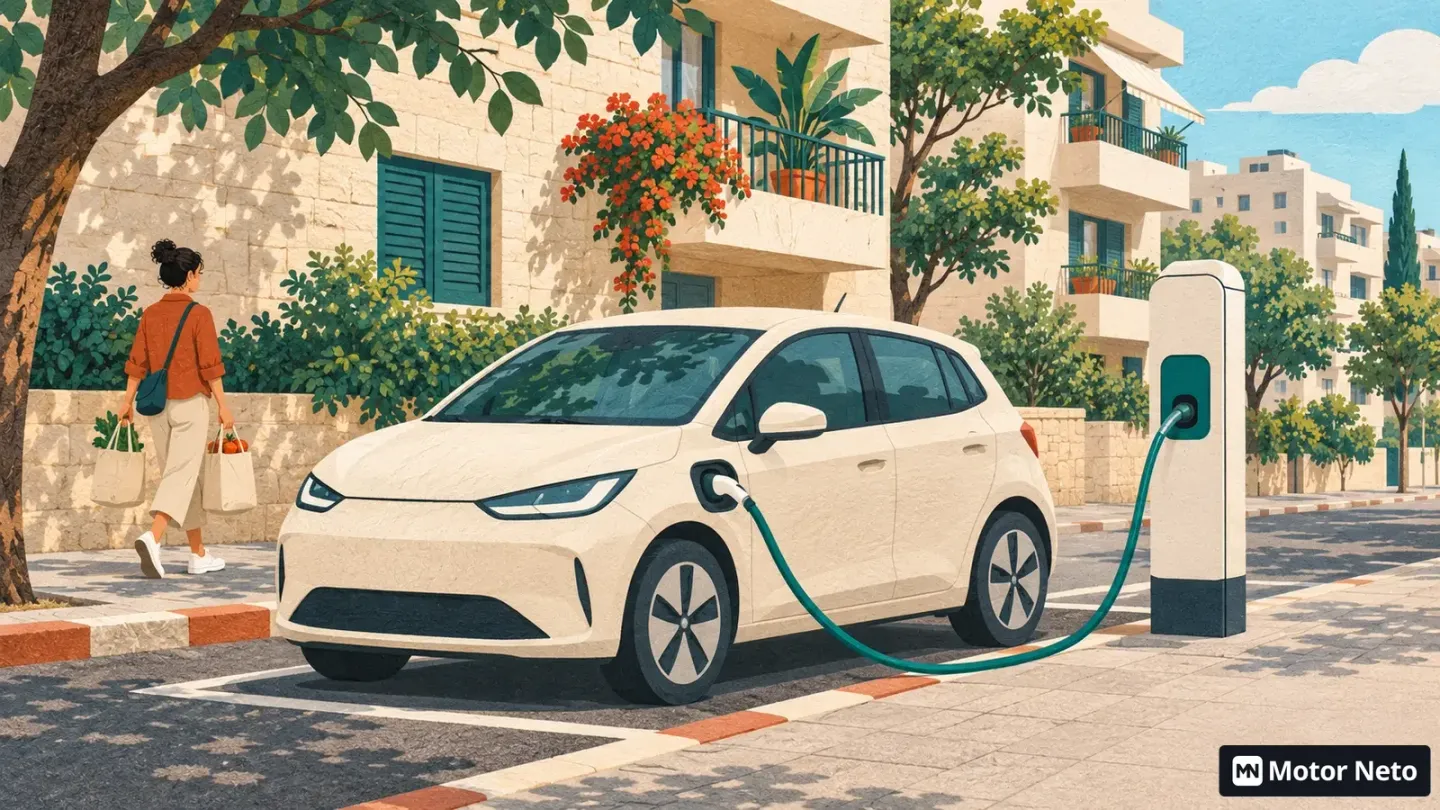
An electric car can suit you without home charging if you have a regular option, a reliable backup and a total cost that fits your budget. Do not start with the advertised driving range. Start by asking where the car will charge in a normal week, how much time that will take and what you will do when your usual charger is unavailable.
A nearby charger on the map is useful information, but it is not a charging routine. You need to know whether you can access it at your usual times, whether the connection is compatible, how payment works and which additional charges apply. Once those answers are written down, you can assess the car itself instead of basing the purchase on an assumption that everything will work out after delivery.
Build a charging map around places you already visit
List home, work, shopping and regular destinations. For each place, add how long you stay and whether parking is actually available to you. Charging while the car would be parked anyway can fit your routine differently from a special journey to a charger. Count not just the minutes connected, but also getting there, waiting and returning the car to its parking space.
Choose a main charger and a backup that is not subject to exactly the same restriction. If both are in a car park that closes at the same time, you have not solved evening access. If charging at work depends on a temporary arrangement, ask what happens during holidays, after a change of role or on a day when you work from home.
Visit the locations at the times you expect to use them. Check signage, access and payment methods, but remember that a single visit is not statistical evidence of reliability. It can expose a practical problem, such as paid parking or an unsuitable walking distance, without guaranteeing that the charger will always be free.
Calculate weekly energy before calculating the frequency of visits
Start with expected mileage and energy consumption appropriate to the car and its use. If you use a manufacturer's figure, state the test cycle and do not present it as your own measurement. For conservative planning, you can examine several consumption scenarios, labelled as assumptions rather than established figures.
An illustration only: 300 km a week at an assumed consumption of 18 kWh per 100 km gives 54 kWh. That is an energy calculation based on the assumption, not necessarily the quantity that will appear on the bill, because the measurement method and charging losses also need to be considered.
The next step is to understand how much energy you intend to add at each stop and the model's charging limits. Do not automatically divide battery size by the maximum power on the sign and present the result as a guaranteed time. Charging performance also depends on the car, battery condition and the circumstances of the charging session.
The price per kWh is only the start of the calculation
Check the tariff by location and time, subscription conditions, parking charges and any charges for remaining at the charger. Consult the operator's information before each charge. The Tesla charging fees page for Israel illustrates why additional terms beyond the energy price also need to be read; each network's conditions must be checked separately.
| Item | What to establish | How to include it in the budget |
|---|---|---|
| Energy | The price and billing mechanism at the charger | Billed quantity multiplied by the tariff |
| Subscription | The price and conditions of the benefit | Only if you choose to join |
| Parking | A separate charge and when it starts | Based on the actual length of the stay |
| Remaining connected or congestion | When the charge applies | According to the operator's conditions |
| A dedicated journey | Additional distance and time | Money and time counted separately |
Energy
- What to establish
- The price and billing mechanism at the charger
- How to include it in the budget
- Billed quantity multiplied by the tariff
Subscription
- What to establish
- The price and conditions of the benefit
- How to include it in the budget
- Only if you choose to join
Parking
- What to establish
- A separate charge and when it starts
- How to include it in the budget
- Based on the actual length of the stay
Remaining connected or congestion
- What to establish
- When the charge applies
- How to include it in the budget
- According to the operator's conditions
A dedicated journey
- What to establish
- Additional distance and time
- How to include it in the budget
- Money and time counted separately
Do not use a domestic electricity tariff to prove a saving when you have no home charging. A one-off promotional tariff is not necessarily a basis for a long-term budget either. Compare costs using the locations where you expect to charge, and add a scenario in which some charging moves to a more expensive network.
If you are considering home charging in the future, the home charging cost estimate provides a separate scenario for comparison. It does not replace the calculation for the public charging on which you will currently rely.
Make sure the car can make use of the charger
Check with the importer which connectors and charging capabilities the Israeli version has. A charger's power rating does not guarantee that the car will accept that power, and support for a particular charging type does not, on its own, define the time needed. Ask for a charging figure with starting and finishing conditions, rather than just a peak number.
Check which equipment is included with the car and how to use it in accordance with the manufacturer and operator's instructions. This guide does not provide electrical installation instructions or directions for using improvised connections. If you later want private infrastructure, compatibility and installation need to be discussed with qualified professionals under the applicable instructions.
Convenient access to the car's charging socket matters too. With a demonstration car, you can assess whether the connector's position suits the parking spaces you will use, without operating equipment contrary to instructions. It is a small question compared with the car's price, but one that returns at every charge.
Assess a charging subscription against the expected savings for your quantity. As an arithmetic example only, a subscription costing 30 ₪ that gives a discount of 0.30 ₪ per kWh breaks even at 100 kWh a month, before other conditions. These are illustrative figures, not an operator's tariff. Put the actual price you have been offered into the calculation.
A long day needs a different plan from a normal week
Check a long route that you actually drive: the destination, possible stops and backups. Allow a planning margin, and do not turn advertised range into a promise that you will arrive with a certain percentage remaining. Changes to the route, traffic, weather and use of the car's systems can alter consumption.
The US government source AFDC recommends that consumers consider daily and longer journeys separately, along with charger compatibility. The principle is useful here too, but US prices, connectors and infrastructure are not figures for the Israeli market. In Israel, you need to plan the route around your car and local operators.
Also ask who will manage charging in the family. If several drivers use the car, make sure everyone knows the usual arrangement and what to do when it is unavailable. A car that suits the person managing the purchase also needs to suit whoever takes it on a day when the plan falls apart.
Rehearse the routine before signing
Try planning a whole week as if you already had the car. Mark when you would charge, where you would be while waiting and what the cost would be at the tariffs checked. If you can try the car and charging through an organised, permitted arrangement, use that opportunity to assess the routine, not to declare a driving range based on a short measurement.
Compare the result with a conventional hybrid and a plug-in hybrid as well. There is no need to force an electric solution to suit every household. Equally, the absence of a private socket does not automatically rule it out if other infrastructure provides a consistent, convenient solution.
Include the full cost of the car, including insurance, purchase and maintenance. Energy savings alone do not prove that the overall purchase is cheaper. Convenience can also justify a choice, provided you know what it requires of you.
Checklist before you continue
If the routine works on paper and in a practical check, you can move on to choosing a model. If it repeatedly needs luck or improvisation, resolve the infrastructure before buying the car.
Useful tools for this topic
- Home EV charging cost calculator and petrol comparisonEstimate the electricity cost of your driving using a domestic tariff and charging losses, and compare it with petrol spending.
Found an error or outdated information? Read how we handle corrections and sources, or email us: [email protected].