

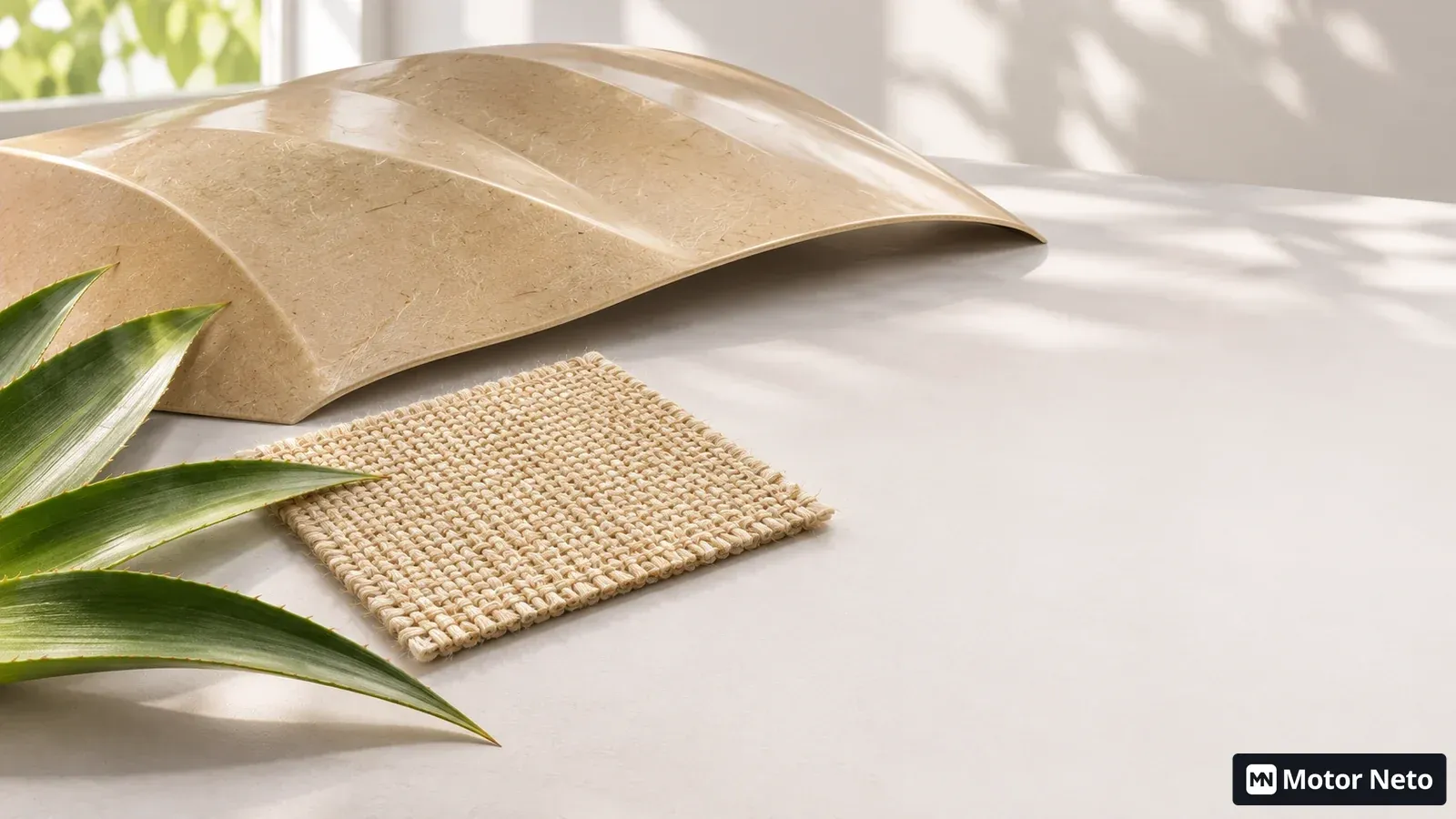
Nissan and FOOD REBORN announced on 17 November 2026 that they had developed exterior body panels from plastic reinforced with fibres derived from pineapple leaves. Nissan’s published image shows a demonstration bonnet. The interesting development is how the fibres become a material that can be moulded into a component, rather than a new car that customers can order.
According to Nissan’s announcement, the process extracts fibres from the leaves, makes flat yarn, weaves fabric and impregnates it with resin to create an intermediate moulding material. Nissan is licensing the manufacturing knowledge to its partner. The panel is due to appear at SAMPE Japan in Tokyo from 18 to 20 November. No production model, price or Israeli availability date was announced.
The leaf is a raw material, not the finished component
The term composite matters here. This is not a leaf pressed into a bonnet shape and left on its own. The fibres form part of a system that also includes resin. The finished product depends on the process and combination of materials, so the shorthand “pineapple bodywork” does not fully describe what has been shown.
The intermediate stages deserve attention too. Yarn, woven fabric and resin-impregnated material are separate stages before a shaped component. The announcement concerns both finding a fibre source and transferring knowledge that enables manufacture. A licence for that knowledge does not, by itself, provide a production rate, component quantity or customer cost.
For readers interested in how an idea becomes a car, this connects with the engineering choices behind the Mazda MX-5. In both cases, a useful starting question is what job the component is meant to do. This is a way of reading technology, not a comparison between the cars or a claim that Mazda uses the new material.
What a tensile test says, and what it does not establish
Nissan says the material has greater tensile strength than conventional natural-fibre materials based on flax. The accompanying note attributes that finding to the company’s internal tests. The announcement gives no numerical percentage improvement, and its wording should not become an estimated percentage or a proven safety advantage for a complete car.
The stated comparison is limited to the material and property tested. It does not present a crash-test result, approval for a particular replacement component or performance after repair. Those are different questions requiring their own relevant evidence. A demonstration bonnet does not settle them.
The same boundary applies to the environmental proposition. The company presents the development as using an underutilised resource, but the announcement supplies neither a complete lifecycle assessment nor a quantified reduction in emissions per car. The development direction can therefore be reported without assigning an unpublished environmental score.
A Tokyo display is not an Israeli parts catalogue
The exhibition is the next public step. For readers in Israel, it offers an occasion to see further information about the development, not a local sales launch date. The announcement contains no compatible-model list, ordering part number or warranty terms for an Israeli consumer.
If such a component eventually appears in a repair quotation, the practical question will be exactly which part it is and what documentation accompanies it. When reading a garage quotation, separate the material’s name from the component’s identification, suitability for the car, proposed work and warranty. A new material name replaces none of those details.
For now, this is news about a process and material that have reached the demonstration-body-panel stage. The next questions concern the application, further published data and the transition to production. The current announcement offers a starting point for those questions, rather than a ready commercial answer for a car owner.
Found an error or outdated information? Read how we handle corrections and sources, or email us: [email protected].