

The engineering story of the Mazda MX-5 starts with a list of things that did not go into the car: small rear seats, a powered roof and forced induction. According to Mazda's published history, those choices were not intended merely to make the product cheaper. They were intended to preserve a clear idea of a lightweight, two-seat roadster with a direct connection between driver and machine.
That angle is more interesting than a list of achievements. Rather than starting by asking how much power could be added, the development team asked which decisions would allow the car to remain what it was intended to be. This history is not our own road test. It is told here with a distinction between the facts Mazda documents and the meaning that can be drawn from them.
Other layouts were considered before rear-wheel drive
In the first chapter of the model's history, Mazda describes considering front-wheel drive, rear-wheel drive and even a mid-engined layout. The final choice of a front engine and rear-wheel drive was not predetermined. The manufacturer explains that some alternatives would have made it easier to use existing assemblies and reduce development costs.
The team nevertheless chose rear-wheel drive and an open body, defining its development philosophy through the Japanese expression Jinba Ittai, which describes unity between horse and rider. This expresses the manufacturer's philosophy, rather than providing an engineering measurement of a sensation. Its historical value lies in how it became a criterion for selecting solutions.
Viewed as a design process, this is an important point: using readily available assemblies is not necessarily a bad decision, and developing new ones is not good simply because it costs more. The question is whether the solution serves the car's purpose. In this case, according to Mazda, the product's purpose determined the direction before its specification became a list of numbers.
Two seats and a manual roof were decisions about the car's identity
The engineering chapter of the official history records the rejection of a proposed layout with two front seats and two small seats behind them. The team chose to concentrate on a roadster for two. It also chose a manually operated soft top in the interests of keeping weight down.
Mazda notes the use of computer analysis of the body to combine rigidity and weight considerations with the safety requirements of the time. That last qualification matters: it does not imply that the original model meets the safety expectations of a new car today. It is a fact about the historical development process, not a contemporary safety comparison.
Leaving out additional seats also clarifies whom the car is not intended for. Instead of offering partial practicality to almost everyone, it defined a narrower role. From a systems perspective, this can be seen as a way to prevent compromises from accumulating: every additional requirement had to justify the space and weight it added.
Less power did not mean less engineering
According to Mazda, the first generation was developed around a 1.6-litre, four-cylinder, 16-valve engine without a turbocharger or supercharger. The manufacturer describes an aim of achieving linear power response and reducing mechanical losses. There is no attempt here to claim the engine was the most powerful in its class or to add a power figure unnecessary to the explanation.
That choice does not mean the car was designed simply in every respect. Its suspension used double wishbones at all four wheels, and the records describe the development of a frame rigidly linking the gearbox to the differential. Mazda calls it the Powerplant Frame and attributes a role in the driveline's feel to it.
Those two details reveal a set of priorities: you can forgo extra power while investing in a structure that connects components. This is an interpretation of the documented decisions, not a basis for proving how a decades-old car of unknown condition will feel.
Material choices served the same direction
In the chapter on its development philosophy, Mazda describes using an aluminium bonnet and choosing a stainless-steel exhaust component instead of a cast-iron solution that had been considered. The manufacturer offers these examples to illustrate attention to detail and the relationship between material, weight and function.
There is no need to turn every material choice into a myth. What is interesting is that the team did not consider each part in isolation solely by its cost. When the goal is defined in advance, one component may receive greater investment while another item is removed altogether. The desired result is a coherent system, not necessarily a long equipment list.
The same principle helps us understand cars today. Before deciding on the strength of one figure, it is worth asking what the model was designed to do and what it sacrifices to achieve that. Building a shortlist around your driving routine is the consumer's version of that question: what matters enough to dictate the other choices?
The route to the showroom also involved testing public reactions
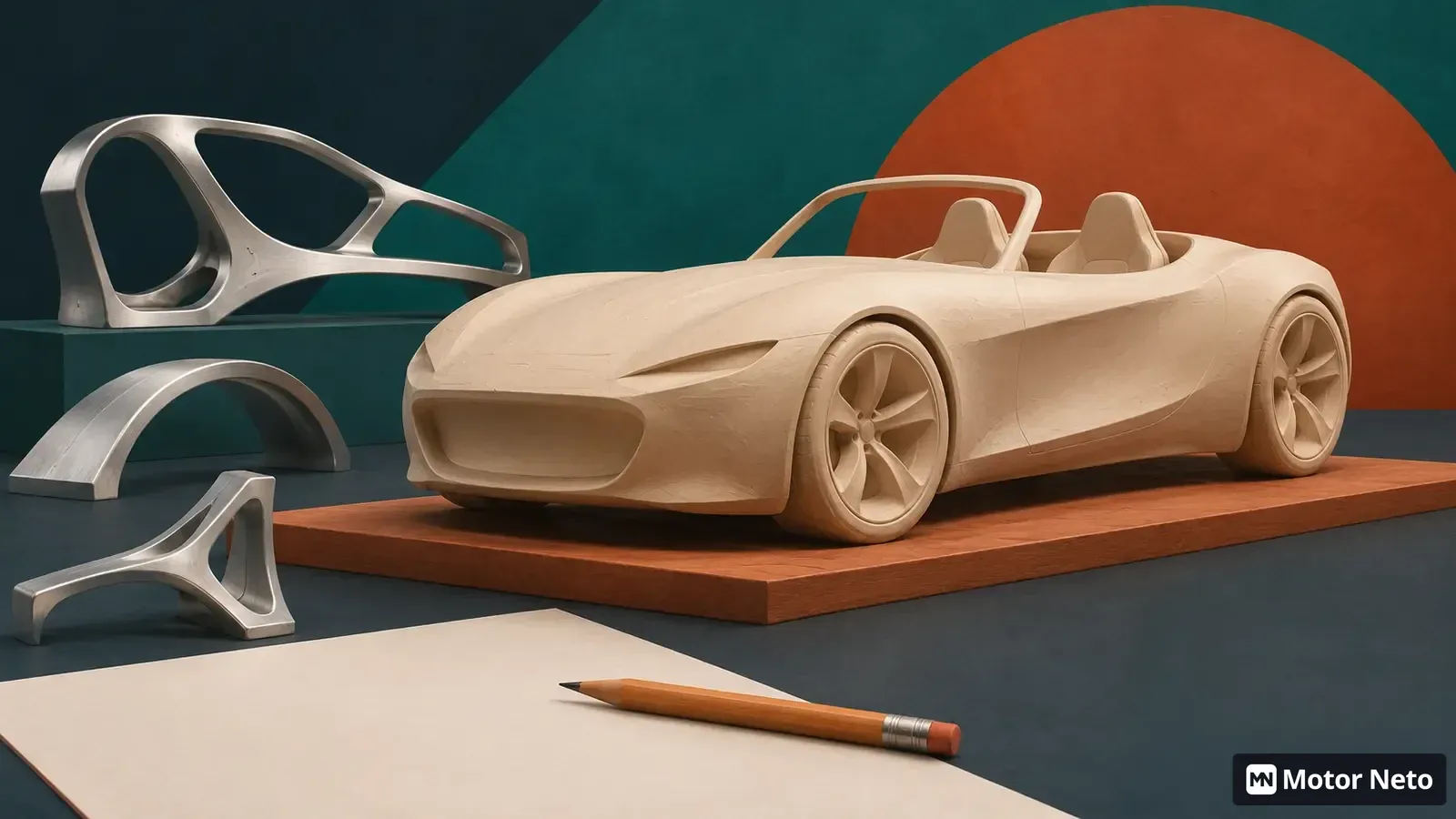
Mazda's documentation describes design development that began at its North American centre and later moved to Japan. In January 1986, a decision was made to transfer leadership to the Japanese team, and that summer an almost complete clay model arrived in Hiroshima. These are stages in the process, not a date when the car was already ready for sale.
In April 1987, a prototype with a plastic body was shown in the United States to an audience interested in cars. According to Mazda, the responses influenced the decision-makers. The car reached the US market in spring 1989, and sales in Japan began in September under the Eunos Roadster name.
The move between development centres and the audience research add context to the engineering story. A clear idea still needs to become a product that can be manufactured and sold. There is no need to invent a dramatic conflict to see the tension between design requirements, cost and demand: it is already present in the decisions Mazda chose to document.
What this history tells a buyer of an older car
The story explains why the model is interesting, but it does not inspect the car in the advertisement. Replaced parts, modifications and body condition can take a particular example away from its original specification. Knowing the engineering concept helps you ask good questions, but it does not replace a professional inspection and a maintenance history.
Anyone considering a dream car on the used market needs to separate appreciation of the design from a decision about the deal. You can love the idea of a lightweight roadster and still walk away from a car with missing documents or one that does not fit your maintenance budget.
What remains from the process is a lesson in priorities. The car gained its identity not only from the items added to it, but also from the decisions to leave things out. That explains the direction in which it was developed without asking the reader to believe in driving impressions from a test that never took place.
Found an error or outdated information? Read how we handle corrections and sources, or email us: [email protected].