
The short answer
Work from the cheapest checks to the most expensive: first the advert and public information for the registration number, then a conversation with the seller, then a meeting and drive, and only then a paid inspection. Money changes hands only after you have checked pledges and attachment orders, on the day ownership transfers to your name.
Who this guide is for
For anyone buying a used car from a private individual or dealer who wants an orderly process, including first-time buyers. This guide does not replace a professional inspection of the car itself.
If the purchase depends on finance, calculate the loan repayment and total payments in advance using the offer you have, so that your purchase budget also includes the cost of borrowing.
Why the order matters more than the list
Almost every buyer knows they should “check the car”. The problem is that an inspection costs money and takes half a day, and anyone who takes the first car they like for inspection can end up paying repeatedly. Buyers who filter properly from home reach the inspection stage with one car, sometimes two.
The principle is simple: each stage should eliminate candidates at a lower cost than the next. An advert can rule out a car for free. A registration number can do the same. A phone call costs ten minutes. Only a car that passes all those checks merits a journey, and only one that also passes that stage merits a paid inspection.
Still unsure whether to buy used? The comparison of new and used cars by cost and risk belongs to the stage before this checklist.
Step 1: read the advert like an investigator
A good advert answers questions. A problematic one avoids them. Pay attention to three things:
- What is missing. No mileage, no ownership count, no photograph of the illuminated instrument panel? That does not necessarily mean fraud, but it is the first question for your conversation.
- A price far below the market. A price much lower than similar cars is not a bargain until someone has explained it. A reasonable explanation sometimes exists, such as an urgent sale before moving abroad, but it must hold up through the later checks too.
- General wording. “Well kept”, “maintained” and “accident-free” are statements, not facts. Write them down. Later you will ask to see the documents behind them.
Step 2: what you can find out from home using the registration number
Before making a call, enter the registration number in the Ministry of Transport and Road Safety's public databases. The private vehicle history database on gov.il shows the recorded mileage and whether changes such as a colour change have been made for active private cars from 2017 onwards. A complementary database shows how many previous ownerships the car has had and their type, such as private, leasing or rental.
Compare what you find with the advert. A second-owner car in the advert but a fourth-owner car in the database, or an earlier mileage reading higher than the advertised one, is good reason to move to the next car without apologising.
Remember what the databases do not know: they do not tell you about accidents, the quality of servicing or mechanical condition. A car with a “clean” database record has passed an initial filter, not an inspection. The guide to what you can learn from a registration number explains each database and the information it lacks.
To cross-check the model and vehicle licence (רישיון רכב) renewal date, add a registration number check in the vehicle register. It does not include the mileage or ownership history described here.
Step 3: a ten-minute phone call
The aim is to hear clear answers, not to negotiate. Ask:
- Who is the registered owner, and are they the person selling? A car sold “for a brother” complicates the ownership transfer (העברת בעלות).
- Are there servicing invoices, and where was the car maintained?
- Has the car been involved in an accident, and were insurance claims paid for it? Ask the seller to prepare an insurance claims history report for the meeting. Only the owner can obtain it, and a seller with nothing to hide will usually agree.
- Is there a loan, pledge (שעבוד) or attachment order (עיקול) on the car?
- Does the seller agree to an inspection at a centre you choose?
Refusal to allow an inspection, or insistence on a particular inspection centre, ends the conversation.
Step 4: the meeting and drive
Arrange to meet in daylight, near the seller's home rather than in a random car park. Before starting the engine:
- Compare the seller's identity card with the name on the vehicle licence, and the chassis number on the licence with the one stamped on the car.
- Ask to start a cold engine. An engine warmed up beforehand hides noises and starting difficulties.
- Examine the bodywork in the light: differences in colour between panels, uneven gaps between doors and wings, and paint marks on rubber seals indicate a repair.
- Check that all warning lights come on when the ignition is switched on and go out after the engine starts.
During the drive, listen more than you admire: noises when braking or turning, pulling to one side on a straight road, smooth gear changes. You are not expected to diagnose a fault. You are deciding whether the car is worth taking to the next stage.
Step 5: the inspection and how to read its findings
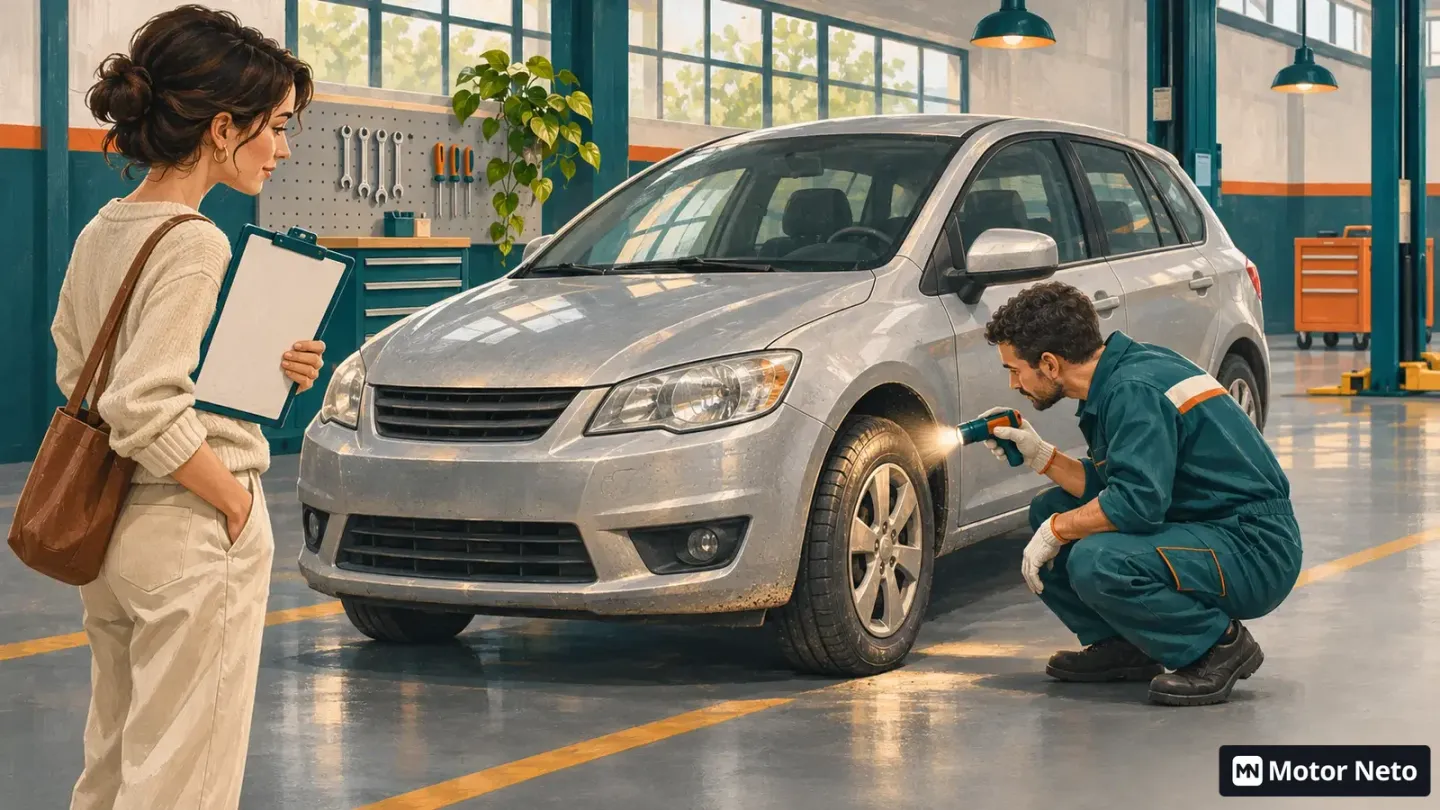
A pre-purchase inspection at an authorised centre is the only stage at which a professional raises the car and looks underneath it. Choose the centre yourself, preferably one with no connection to the seller, and be present.
The report will almost always contain findings. The question is what kind:
- Normal wear, such as tyres, brake pads or a battery, is material for negotiating the price.
- Chassis damage, signs of flooding or substantial leaks are usually reasons to walk away, even if the price is tempting.
- A finding you do not understand is not a minor finding. Ask the inspector to explain its significance and the estimated repair cost, and write down the answer.
Step 6: money and ownership change hands on the same day
Before paying, check that there is no pledge on the car in the Ministry of Justice's Registrar of Pledges (רשם המשכונות), and no attachment order recorded at the Licensing Office (משרד הרישוי). A pledged car could be taken from you even if you have paid its full price.
Ownership can be transferred in one of two ways: at a post office, with both parties present and carrying their identity cards and the vehicle licence, or online through the government personal account (האזור האישי הממשלתי), where the seller and buyer identify themselves and approve the transfer. Current details and the fee appear on the “Registering a change of vehicle ownership” (רישום שינוי בעלות ברכב) service page on gov.il.
Three rules for that day:
- Pay using a method that leaves a record, such as a bank transfer or banker's cheque, rather than cash.
- Sign a brief sale memorandum (זיכרון דברים): the parties' details, vehicle details, price, mileage and the seller's declaration about accidents and pledges.
- Activate compulsory motor insurance (ביטוח חובה) in your name before driving away. The seller's insurance does not cover you.
The short checklist to print
Checklist before you continue
When to stop, even if you have already invested time and money
The dangerous moment in a purchase comes after the inspection. You have already paid, already lost a working day, and in your mind the car is almost yours. That is exactly when people buy cars they should not buy. The inspection fee is the price of knowing, not a deposit on the car. If the findings are bad, the inspection has done precisely what you paid for.
Useful tools for this topic
- Vehicle registration number lookup: car details and licence expiryCheck vehicle details, the last roadworthiness test date and licence expiry against the Ministry of Transport register.
- Car loan calculator: monthly repayments, interest and balloon paymentCalculate monthly repayments, total interest and payments from the loan terms you enter, with or without a final balloon payment.
Found an error or outdated information? Read how we handle corrections and sources, or email us: [email protected].