
The short answer
Follow the precise maintenance schedule for your vehicle and its conditions of use. When the manufacturer specifies time or mileage, whichever comes first, track both rather than substituting a general interval found online.
Who this guide is for
For drivers who cover few kilometres, build up mileage quickly or have bought a car with an incomplete service history.
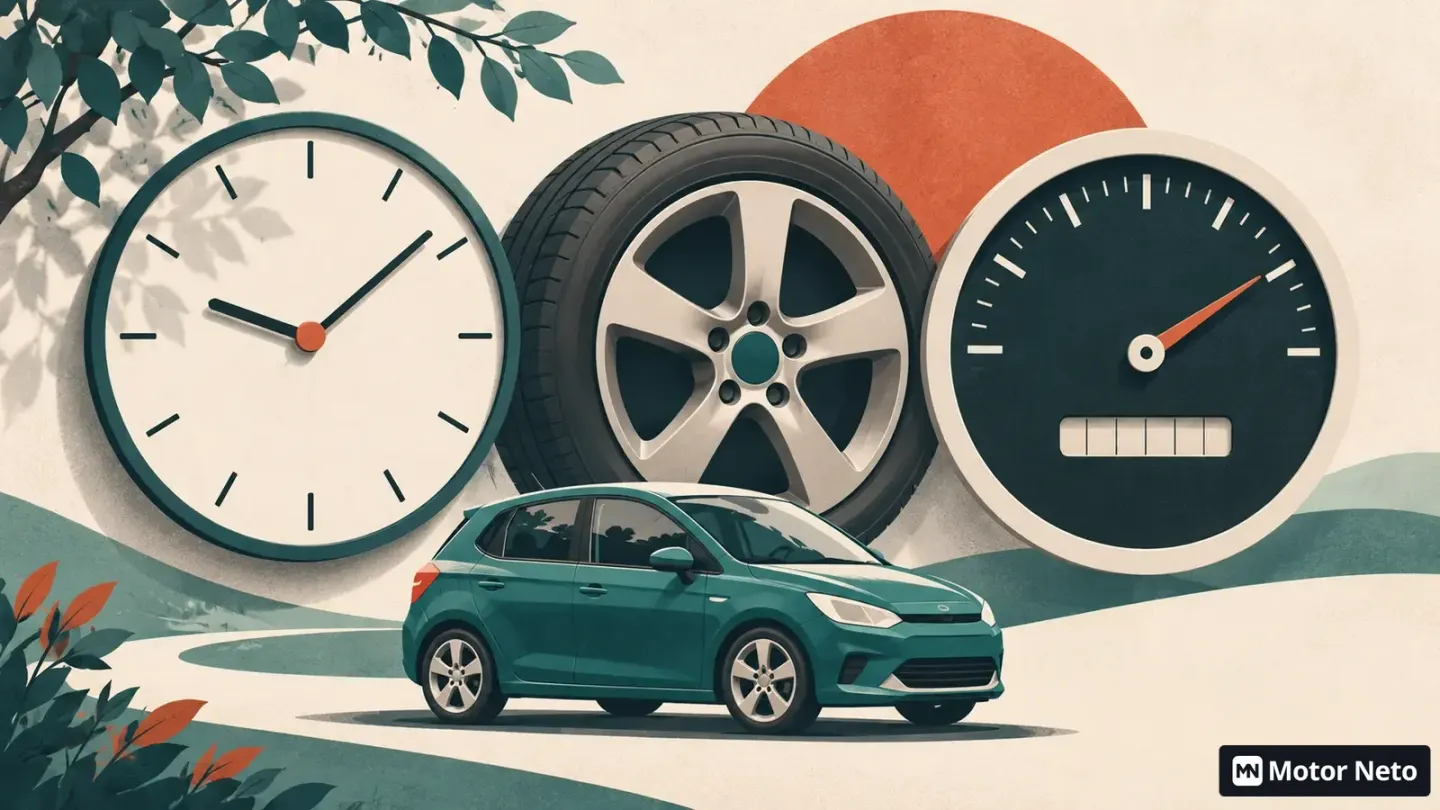
A service becomes due according to the vehicle's precise maintenance schedule, including its conditions of use and the manufacturer's notes. If the schedule specifies time or mileage, whichever comes first, track both. Covering few kilometres is not an automatic reason to skip a service, and high mileage can make one due before a year has passed.
There is no single service interval that suits every car. Even within the same model name, schedules may differ by production year, engine or market. Before asking whether it is time to change the oil, make sure the document you are using actually describes your vehicle. From there, you can build a simple plan that does not depend on guesswork.
Find the right document for the specific vehicle
Have the vehicle licence (רישיון רכב), chassis number (מספר שלדה), production year and powertrain details ready. Look in the owner's manual, warranty booklet and importer's website for the appropriate maintenance schedule (לוח אחזקה). For example, Toyota's service website in Israel lets you find a schedule by model and production year. The very existence of that filter is a reminder of why the model name alone is not enough.
If you are unsure which of two versions is yours, contact the service provider with the chassis number and ask for written identification. Do not choose the schedule with the longer interval because it suits your budget. Even a document that looks official but belongs to another market may not suit local conditions or the version sold in Israel.
Keep the file and the date you received it. When an update or clarification is issued, keep it alongside the previous document. The aim is not to build a large archive, but to know which instruction the last service followed and what has changed before the next one. If you receive a verbal answer, ask to be directed to the precise section.
Read each line according to the work it specifies
A maintenance schedule is not a uniform replacement list. Some items require inspection, others replacement, and others action under particular conditions. Read the key and notes. An inspection symbol does not mean that the component will be replaced at every visit, and no replacement during a particular service does not mean the component needs no further monitoring.
Ask how inspection findings are recorded. If replacement is found to be necessary, ask what the finding was. If it is a scheduled operation, ask for it to be linked to the relevant line in the schedule. This lets you distinguish maintenance required by the manufacturer from an additional garage recommendation, without assuming in advance that either is unnecessary.
Consider fluids, filters, braking components, tyres and other systems separately, according to the relevant instructions. Do not assume that the oil change date is necessarily the due date for every other item. Electric vehicles also have a maintenance plan; the absence of a combustion engine is not a document exempting them from every inspection or service.
Two clocks can lead to the same garage appointment
Suppose, purely for illustration, that a particular schedule requires an operation every 12 months or 15,000 km, whichever comes first. These are example figures, not a servicing recommendation for your vehicle. If a year has passed and you have covered only 6,000 km, the time limit has arrived first. If you have covered 15,000 km in eight months, the mileage limit has arrived first.
| Illustrative scenario only | Which limit came first | What it means |
|---|---|---|
| 12 months and 6,000 km | Time | Do not wait to reach the mileage limit |
| 8 months and 15,000 km | Mileage | Do not wait for the year to end |
| Neither limit has been reached | Neither | Continue monitoring according to the schedule |
12 months and 6,000 km
- Which limit came first
- Time
- What it means
- Do not wait to reach the mileage limit
8 months and 15,000 km
- Which limit came first
- Mileage
- What it means
- Do not wait for the year to end
Neither limit has been reached
- Which limit came first
- Neither
- What it means
- Continue monitoring according to the schedule
Also check the point from which the interval is counted. Not every operation is recalculated in the same way after a visit, and not every invoice means a full service was completed. Keep the odometer reading and date for work that was actually done. If information is missing, ask the garage to work with you on a follow-up plan that acknowledges the gap.
Severe use is defined by the manufacturer
Some schedules include additional requirements for specified conditions of use. Read the exact wording rather than deciding that every urban journey automatically counts as severe use, or that a low-mileage car necessarily operates under mild conditions. A discussion with the service provider should begin with a description of how you use the car, rather than a general statement about Israel's climate.
Describe journey frequency, distances, prolonged stationary periods or special use where relevant. Ask which instruction applies and why. If the manufacturer specifies a different interval for those conditions, include it in the plan. If a proposed change has no clear basis, ask for an explanation before presenting it as a manufacturer requirement.
An unknown history also needs a practical response. For a used car without full records, there is no justification for assuming that every operation was completed, nor for inventing neglect. A professional should assess its condition and explain what was inspected, what was replaced and what still depends on a missing document.
A dashboard reminder does not contain the whole owner's manual
A service reminder can help, but you need to understand what it represents in your vehicle. Is it based on time, mileage, a usage calculation or another setting? The answer is in the appropriate manual. Do not compare one car's display with another and infer from that when a service is due.
If the reminder does not match the documents, ask for clarification. Resetting a message is not proof that the work was done, and a general invoice is not a breakdown of every operation. Ask for a record of which items were completed and when the next service is due under the instructions. There is no need to reset a system yourself simply to stop seeing a message.
Also distinguish a maintenance reminder from a fault warning light. A service planned for a month's time is not an answer to an alert requiring action now. When a new message appears, follow the relevant instruction rather than assuming it can wait for the scheduled visit.
Build a useful service file for the next purchase
Keep invoices showing dates, mileage and details of parts and work. Add inspection documents and clarifications received from the importer. Such a file helps you understand what has already been done, track warranty matters and present an orderly picture when selling. There is no need to include personal information that is unnecessary for documenting the vehicle.
Before every service, review the schedule and the previous invoice. Request a detailed quote for the expected work and separate additions that require diagnosis. This allows you to plan spending without turning the schedule into an instruction to replace every part on it unquestioningly.
The information here is not a repair instruction and does not replace the manufacturer's directions. It enables you to arrive with a precise question: what does this vehicle need now, under which section, and what was actually done last time?
Checklist before you continue
Once this information is organised, the decision no longer depends on the feeling that you have not driven enough yet. It rests on a clear schedule and on what has actually happened to your vehicle.
Found an error or outdated information? Read how we handle corrections and sources, or email us: [email protected].