
The short answer
Choose springs if the dampers are sound and you already know the ride height you want. For the 2015 to 2017 coupé, example hardware budgets are about 1,550 ₪ for springs or 5,300 to 5,900 ₪ for an adjustable kit, before freight and fitting.
Who this guide is for
For Mustang GT coupé owners with conventional dampers and those checking MagneRide compatibility.
Start with a measurement on level ground
Measure from the centre of each wheel to the wheel arch on level ground. That measurement remains comparable if you change tyres. Separately check clearance under the nose on the ramp you actually use. Two cars can sit equally well in a photograph and only one may clear your driveway. Note any load you regularly carry in the boot. A shorter spring leaves less available bump travel if the rest of the assembly stays in place.
A fixed spring or a height you can revisit
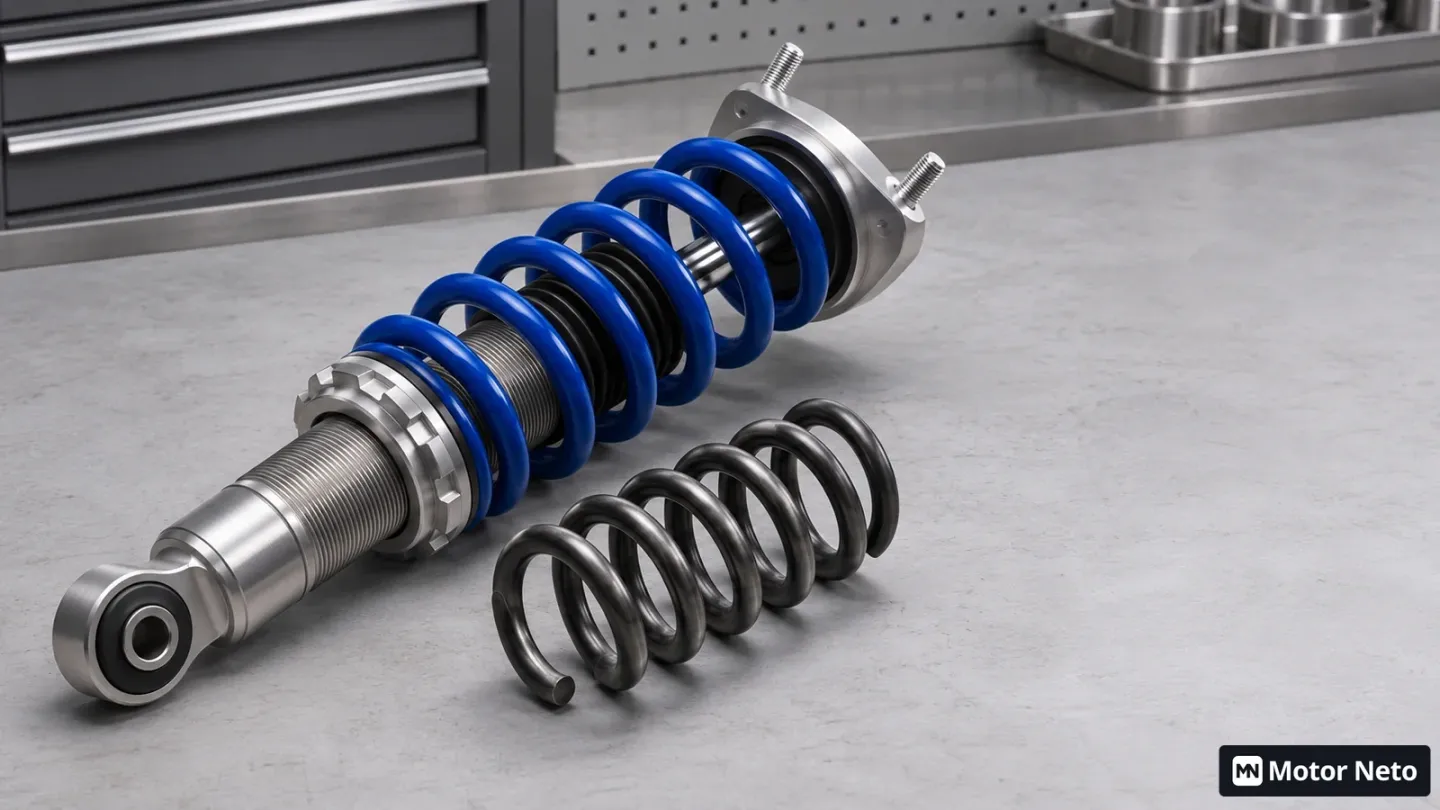
For the US 2015 to 2017 coupé, Eibach lists PRO-KIT 35145.140, tested with factory dampers. It quotes a drop of about 28 mm at the front and 25 mm at the rear and excludes magnetic dampers. The spring carries the weight. The damper controls movement after a bump. New springs on tired dampers will not cure persistent bouncing. On a later GT, verify the suspension code before ordering.
Pedders’ eXtreme XA PED-160099 offers ride height and damping adjustment. That flexibility pays off if you measure and record changes. The standard S550 rear suspension has separate springs and dampers. Ask which adjusters are supplied for each axle. MagneRide adjusts damping electronically as you drive. Replacing it with passive dampers requires a solution for that specific application. Record the baseline so you can return to it after experimenting.
Budget separately for wheel alignment
On 23 November 2026 Eibach listed four springs at $395. Pedders showed $1,349.96 against a $1,499.95 list price. Using the Bank of Israel’s 20 November rate of 3.326 shekels per dollar and 18% VAT on the parts gives about 1,550 ₪ or 5,300 to 5,900 ₪. These are also the starting DIY budgets. A documented BMR spring installation on a 2017 GT allows three hours or more. Counting just three, at the Tax Authority’s 2024 benchmark of 250 to 500 ₪ an hour before VAT, brings the spring example to around 2,440 to 3,320 ₪. Longer jobs cost more.
Request wheel alignment, a clearance check at steering lock and any specified replacement hardware in the workshop quote. The estimate excludes those, freight, other import charges and their VAT. BMR spring hours do not establish Pedders fitting time. No engine dyno calibration is needed. The relevant measurement is an alignment reading at your chosen final height.
Finish the job at all four corners
Dismantling a front strut can require compressing a loaded spring. Without the right compressor, experience and stable supports, leave strut dismantling to the workshop. A loaded spring must never be released by undoing the top damper nut. Measure again after fitting, check the tyre clears the arch liner and request the before and after alignment printout. Rapid wear on one tyre shoulder can swallow the saving on a cheaper kit. Check the settings and agreed heights against the final invoice.
Checklist before you continue
Found an error or outdated information? Read how we handle corrections and sources, or email us: [email protected].