
The short answer
Approval of a change on the vehicle licence does not by itself determine insurance cover or the importer's warranty. Before work starts, send an accurate description to the insurer and warranty provider, and ask for written replies and updated documents where needed. A modification does not automatically cancel all insurance or the entire warranty.
Who this guide is for
For vehicle owners about to order an upgrade who want to clarify cover, warranty and licensing requirements beforehand, including for electric and hybrid cars.
A vehicle modification may be approved for licensing purposes and still raise questions with the insurer or warranty provider. These are three different checks: whether the vehicle meets the requirements for use, what the insurance contract covers, and which faults fall under the warranty. Before paying the installer, you need a separate answer to each.
The reverse matters too. Notifying an insurer is not permission to make a structural modification (שינוי מבנה), and a warranty given by the installer is not a commitment by the vehicle importer. To reduce disputes, send the same description of the work to everyone involved and retain the replies with the car's details. This is general legal and insurance information based on sources checked as of 10 November 2026; it does not determine the outcome of any particular claim.
First define what you want to insure
Do not settle for a message saying you have added an accessory. Explain what the product is, where it is installed, whether it changes the vehicle specification, what it costs and who is installing it. Attach a compatibility document or licensing approval if required. A tyre-size change, a new screen and engine software are not the same notification, even if all three appear under upgrade on an invoice.
There is a difference between cover for damage to your vehicle, liability for damage to other people's property and compulsory bodily-injury insurance (ביטוח חובה). Do not infer what one policy covers from an answer about another. Ask the insurer or agent to identify explicitly the policy and cover they are addressing and, where necessary, refer the question to someone authorised to approve changes to the terms.
Also ask whether the accessory itself is included in the insured value, whether it needs to be added to the policy schedule and what is required to prove its value. Do not assume that the price you paid will be reimbursed in full following damage. This is a contractual question to clarify in advance, not a conclusion that follows from having an invoice.
The duty of disclosure does not mean every addition cancels insurance
Section 6 of the Insurance Contract Law concerns giving a full and honest answer to a written question about a material matter before entering the contract. Section 17 concerns immediate written notification of a material change during the policy period. The definition relates, among other things, to matters the insurer asked about or expressly identified in the policy as material. Not every small change is automatically a material change under the law.
Where risk has increased, section 18 sets out a mechanism that may include cancellation of the contract or reduced insurance benefits and, in the circumstances it specifies, exemption from payment. Section 19 sets out situations in which the insurer is not entitled to those remedies, including conditions concerning the change's effect on the insured event or liability. There is no justification for skipping the exceptions and declaring that every claim will be rejected.
In practice, it is better to clarify matters before installation than argue about interpretation after damage occurs. Ask for a written reply addressing the description you supplied. If a policy change is required, obtain the updated document; if you are told none is needed, keep that reply too. Acknowledgement that your notification was received is not necessarily an answer about cover.
The importer's warranty and the installer's warranty are different commitments
The vehicle warranty is assessed according to the terms supplied for your car. Toyota's Israeli warranty booklet, which according to its heading applies to cars delivered from June 2022, lists exclusions including changes contrary to the manufacturer's instructions to the specification, tyre sizes, suspension and engine management. The booklet also mentions modifications contrary to the law and products that fail to meet quality and compatibility requirements.
This is an example of one manufacturer's and importer's terms. It does not prove that every importer operates in the same way, or that every installation cancels the entire warranty. Before work begins, contact the warranty provider with the vehicle registration number and installation quote, and ask which assemblies or types of damage may be affected and for a reference to the relevant clause.
Separately, ask the installer for a written warranty covering the product and the work. Ask who diagnoses a fault discovered after installation, who pays for the investigation and how damage to another system is handled. An answer saying the accessory has a one-year warranty, for example, does not explain what happens if the dispute concerns the installation rather than the accessory itself.
For an electric or hybrid car, identify the vehicle warranty and the traction-battery warranty separately. The guide to reading battery warranty terms explains why the number of years in the headline is not enough. Do not treat an accessory powered by low voltage as automatic permission for any modification connected with the electrical systems.
The annual test checks roadworthiness; it does not approve every upgrade
Regulation 273, quoted in the Ministry of Transport and Road Safety procedure, describes an inspection intended to establish whether the vehicle meets the conditions and is fit for use. A structural modification requiring a permit must go through the appropriate process. The guide to car upgrades in Israel explains the distinction between maintenance, installation and registration.
One explicit example of a rule affecting vehicle licence (רישיון רכב) renewal concerns coatings on windows where these are prohibited under regulation 356(d). Another appears in the air-pollution testing procedure for vehicle inspection centres: the integrity of the exhaust and emissions-control systems and the absence of leaks are checked, and preliminary conditions for the inspection are specified.
The police procedure, which concerns roadside inspections rather than serving as an annual-test manual, also lists tyres that do not match the licence, defective lighting and faults in the exhaust system. It is important not to confuse these documents: they establish that roadworthiness and enforcement requirements exist, but do not allow every annual roadworthiness test (טסט) result for every modified car to be predicted in advance.
According to the Ministry of Transport and Road Safety's licence-renewal page, a vehicle that fails must be repaired and inspected according to the type of defect. If a temporary driving permit (אישור תנועה זמני) is issued, its conditions must be followed. It should not be treated as general permission to keep using the vehicle, and certainly not as grounds to disregard a separately issued prohibition-of-use notice (הודעת אי שימוש).
Turn the quote into a document you can assess
A good quote separates the product, labour, required checks or approvals and registration of the modification. Ask it to specify which procedures are included and who is responsible for completing them. There is no universal price list here: a cost absent from the quote does not become zero, and information you have not received is not a basis for comparison.
You can use the guide to reading a garage quote to build a short list of questions. For an upgrade, also ask what happens if incompatibility is discovered before work starts, or if the documents need correcting afterwards. It is worth reaching that agreement before a part is ordered specially.
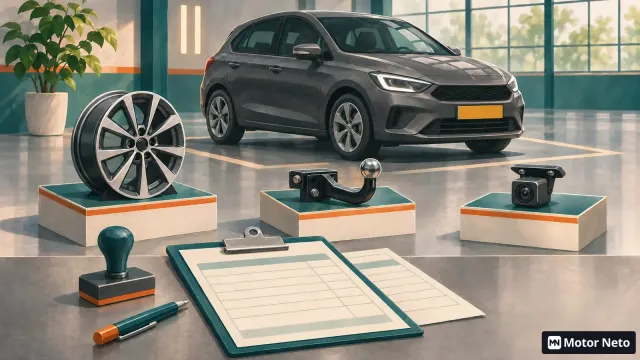
For example, a wheel quote needs to identify the tyre size and intended rim; a tow-bar quote needs to clarify vehicle compatibility and the registration documents. These are examples of how to describe the order, not approval of a particular product. An accurate description allows both the insurer and warranty provider to address the same work.
Checklist before approving the order
Checklist before you continue
Keep the approved quote, invoice, part description, installation approvals and correspondence together in one file. If a further decision was needed after the work, keep that too. Then, when a fault or claim needs investigating, you can start with the facts and written agreements rather than the memory of a conversation at a counter.
Found an error or outdated information? Read how we handle corrections and sources, or email us: [email protected].