
The short answer
Start with a documented full tank, record every amount added and finish with another full refill. Divide total litres by distance over that same period and multiply by 100 for litres per 100 km.
Who this guide is for
Drivers in Israel tracking fuel consumption and running costs, including those who sometimes refill only partly.
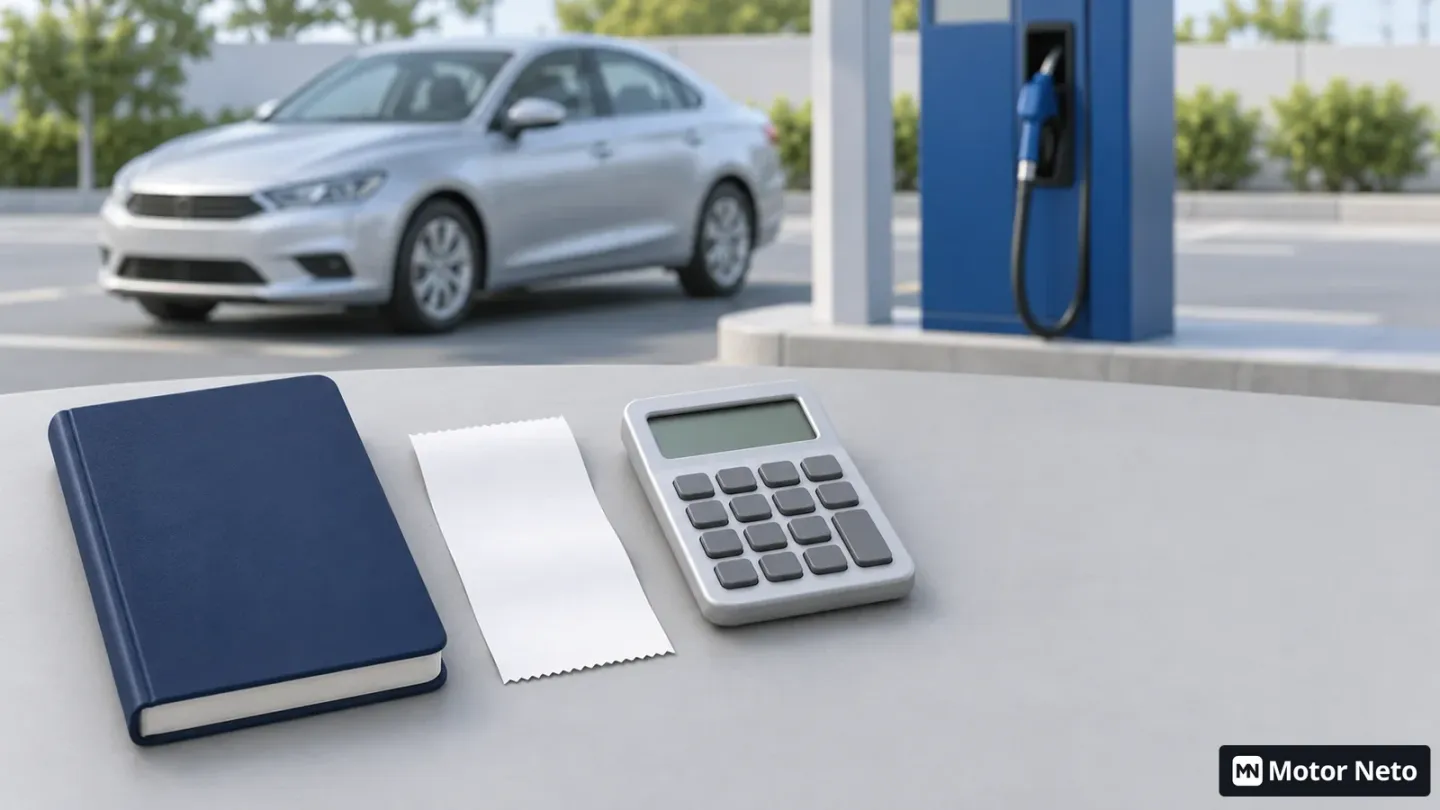
To find out how much fuel your car uses, match the fuel added with the distance covered over the same period. Two receipts showing the same amount in shekels are not enough: the price per litre may change, and the fuel left in the tank may differ. Comparable starting and finishing points turn receipts into a useful record.
The method described on FuelEconomy.gov, the US Department of Energy and Environmental Protection Agency website, begins with a full tank and an odometer reading, then calculates distance and fuel at the next full refill. Here we use kilometres and litres instead of US units. This estimates your own use; it is neither a laboratory test nor a measurement made by our publication in a particular car.
Start with a record you can return to
At the opening fill, record the date, odometer reading and that the tank is full. You can also reset the trip counter, but keep the total odometer reading: accidentally resetting the trip counter will then not erase the basis of the calculation. Distinguish the cumulative odometer from the resettable counter, particularly in a car unfamiliar to you.
The fuel bought at that opening fill is not included in consumption for the period now beginning. It brings the tank to the starting point. Count the litres added afterwards, up to and including the full refill that closes the period. This small bookkeeping mistake can make a substantial difference to the result.
Full does not mean squeezing in more fuel after the automatic shut-off. Follow the vehicle handbook and station instructions; do not keep filling an already full tank to round off the bill. EPA warns that topping off can damage the fuel vapour system or cause overflow. Ford handbooks also emphasise a consistent filling method when comparing results. You do not need to empty the tank or try to reach the fuel warning light to perform the calculation.
Match the litres with the right distance
Suppose, solely as an arithmetic example, you record 20,000 km at the opening fill and 20,600 km at the next full refill. The second fill adds 42 litres. The distance is 600 km, so consumption is 42 divided by 600, multiplied by 100: 7 litres per 100 km. Over the same period, the car travelled approximately 14.3 km per litre.
| Calculation | Formula | Example result |
|---|---|---|
| Distance for the period | Final reading minus initial reading | 600 km |
| Litres per 100 km | Litres divided by km, multiplied by 100 | 7 |
| Km per litre | Km divided by litres | Approximately 14.3 |
Distance for the period
- Formula
- Final reading minus initial reading
- Example result
- 600 km
Litres per 100 km
- Formula
- Litres divided by km, multiplied by 100
- Example result
- 7
Km per litre
- Formula
- Km divided by litres
- Example result
- Approximately 14.3
Both results describe the same use. With litres per 100 km, a lower number means less fuel for the same distance. With km per litre, a higher number means more distance from the same fuel quantity. Always write the unit beside the number, and do not compare 7 with 14.3 as though they describe different cars.
A partial refill need not end your record
If you add fuel without filling the tank, record the amount and mark it as a partial refill. Do not use that receipt alone to close a measurement that began with a full tank: the finishing level differs. You can continue recording until a later full refill and include every litre added in between.
For example, after the opening fill you add 20 litres, followed later by another 25 litres to fill the tank. If the total distance since the opening is 600 km, use 45 litres in the calculation, giving 7.5 litres per 100 km. This is a separate example from the previous one, not a measurement from a real car.
Missing a receipt or quantity? Do not supply a plausible number from memory or enter zero. You can retain the period as an incomplete record and establish a new starting point at a documented full fill. If several people use the car, ensure everyone adds their refills to the same record, including a small midweek purchase.
Calculate a longer average from the totals
To combine several periods, add all the litres and all the kilometres, then recalculate. A simple average of the figures displayed for individual refills may give equal weight to a short journey and a long one. For example, 10 litres over 100 km plus 30 litres over 500 km totals 40 litres over 600 km: approximately 6.7 litres per 100 km. Simply averaging 10 and 6 would give 8, which does not describe the combined period.
Keep a brief note alongside the figures about the use: urban driving, an unusual long journey or a different load. FuelEconomy.gov lists driving conditions, vehicle condition and other factors among the reasons consumption changes. The record helps identify what is actually being compared, without assuming every change is a fault.
Compare with the display and budget carefully
If you want to compare your calculation with the car's consumption display, check the handbook for the period it covers and when it resets. An average since starting the car does not cover the same period as several refills. Even with aligned periods, a refuelling record is not a laboratory instrument; a single discrepancy does not prove a display or engine fault.
In a plug-in hybrid, fuel consumption alone does not describe all the energy used for driving. Record external charging and its cost separately. Do not combine litres and kWh into one number without a defined conversion method, or present fuel not consumed as evidence of cost-free driving.
To estimate a future expense, multiply the expected distance by consumption per 100 km, divide by 100 and multiply by your chosen price per litre. Label it an estimate and date the price. Actual spending is recorded from receipts, alongside the other costs of owning a car. No current fuel price or savings forecast for a particular model is supplied here.
Turn the record into a working tool
If consumption changes over several comparable periods, take the record for professional assessment instead of using it to decide which part must be replaced. Also check servicing intervals by time and distance in the handbook for your car. A consumption record does not replace maintenance instructions or justify delaying a service that is already due.
Checklist before you continue
A notebook, spreadsheet or app can serve the same purpose, provided the record is continuous and its starting and finishing points are identifiable. The most useful figure is one whose underlying inputs you can explain.
Found an error or outdated information? Read how we handle corrections and sources, or email us: [email protected].