
What this overview is based on
A practical planning guide with examples from Tesla and Volvo owner documentation. The arithmetic example is hypothetical, not a standard, an editorial measurement or a parking safety approval.
The short answer
Measure the approach to your parking space and its usable area, then compare them with the exact car version you intend to buy, including its mirrors. Separately check passenger access and tailgate opening. If the fit is marginal or the route complicated, do not commit on catalogue dimensions alone.
Who this guide is for
For buyers of new or used cars in Israel who use a narrow, covered or pillar-constrained home parking space. It also suits owners changing cars who want to understand the everyday difference.
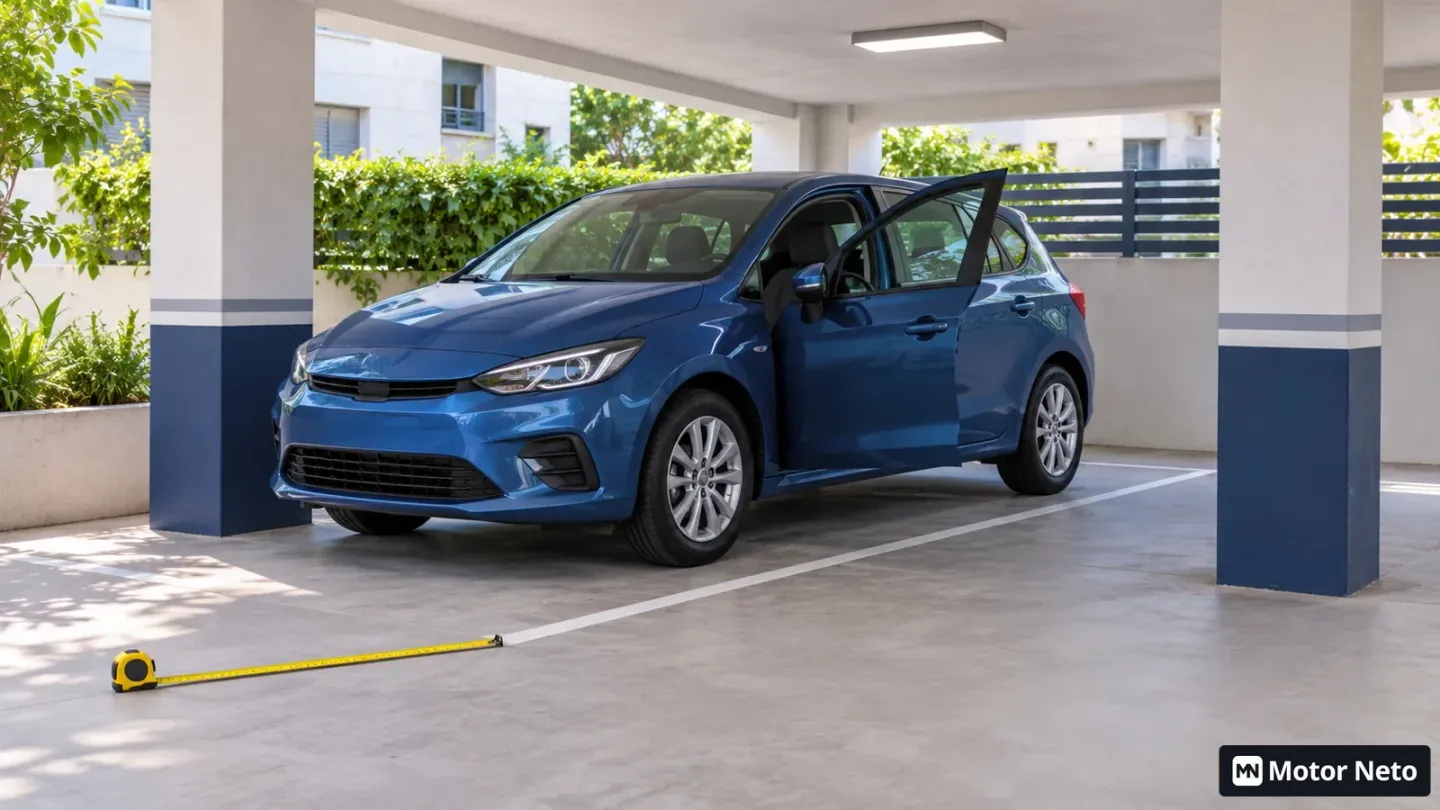
Before choosing a car, check whether you can reach your home parking space, get out of the vehicle and use it comfortably there. Start with a measurement sheet for the location and the exact car. Keep anything uncertain as a question to resolve before ordering, rather than assuming cameras or folding mirrors will solve it after delivery.
Do this while building your shortlist of cars. It can help choose between versions before you spend more time comparing equipment that will not change the parking routine. This guide concerns practical suitability for the vehicle and its users. It does not determine compliance with parking standards or the legal registration of a space.
Start with the approach, not the rectangle at the end
Walk the route from the entrance to the space only when it is clear and safe to access. Mark gates, bends, pillars, fixed cabinets, projecting walls and changes in height. A comfortable width inside the bay does not mean the approach is equally accommodating. A wide-angle phone photograph can also obscure the difference between a narrow point and the space beyond it.
Measure between the obstacles themselves, rather than just between painted floor lines. Record where and at what height each measurement was taken. A pillar with a wider base, for example, may leave different clearance beside a door or mirror. Do not move shared equipment or step into moving traffic to finish measuring; arrange access with whoever manages the location.
Add a photograph of each difficult point, with a short description of direction and obstruction. Consider normal use too, with neighbouring cars occupying their spaces. An area that happens to be empty is not reliable room on which to base a purchase. If a complicated route needs professional assessment, give the measurement sheet and photographs to an appropriate specialist.
Find the right width for the right version
Ask for specifications and an owner manual matching the model year, version and Israeli market. Establish whether a quoted width includes extended mirrors, folded mirrors or the body alone. Do not combine the length of one version with the width of another simply because they share a model name. Keep the source document and the date you checked it.
The Israeli Tesla Model Y manual, for example, lists Premium 5-seater widths of 2,129 mm with mirrors, 1,982 mm folded and 1,920 mm without them. Tesla describes dimensions as approximate and dependent on options and other factors.
The practical point is to know which measurement you are comparing. Folding mirrors is not an automatic solution to a narrow route: check the manual for when and how the function may be used and consider what remains visible to the driver. Ask the representative to clarify missing figures. An absent dimension does not make the difference negligible, and a smaller-looking car is not necessarily more suitable at every point.
Simple subtraction screens candidates; it does not approve passage
In a hypothetical example, a 2,400 mm opening and a car with a relevant width of 2,100 mm leave a total difference of 300 mm. Only a perfectly centred car has 150 mm on each side. This is an arithmetic exercise, not a recommended clearance or a finding that passage is safe.
The calculation does not describe turning, deviation from the centre, a slope, door movement or an obstacle at another height. Nor does it establish whether the everyday driver can see the edges and manoeuvre comfortably. Use it to identify questions and reasons to reject a candidate, not to promise a good fit when little room remains.
Make a short comparison sheet that separates your own measurements, specification figures and matters still unchecked:
| Part of the check | What to record | What the number alone cannot establish |
|---|---|---|
| Entrance opening | Usable width and measurement point | Ability to complete the turn into it |
| Parking bay | Length, width and pillar positions | Room to open a door and get out comfortably |
| Ceiling and obstructions | Height at relevant points | Clearance for the open tailgate |
Entrance opening
- What to record
- Usable width and measurement point
- What the number alone cannot establish
- Ability to complete the turn into it
Parking bay
- What to record
- Length, width and pillar positions
- What the number alone cannot establish
- Room to open a door and get out comfortably
Ceiling and obstructions
- What to record
- Height at relevant points
- What the number alone cannot establish
- Clearance for the open tailgate
Do not round a marginal measurement upwards to mark the car as suitable. State whether a figure is approximate and what needs more precise measuring. A small difference on paper can disappear when the starting point changes. That is why the method matters as much as the recorded result.
Check everyday life after the car stops
Work out where the driver's door and passenger doors will open relative to pillars and walls. Someone who exits one car easily may find another less accommodating because of a longer door or a different seating position. Include an ordinary action such as putting a bag inside, rather than testing only the minimum opening through which someone can squeeze.
Consider the people who actually use the vehicle. If a passenger needs more space, a fit that works only for the driver is insufficient. Check access to every necessary seat with the car safely stationary, without using the door as a measuring tool until it hits an obstruction. Cameras and sensors are aids; having them does not establish that the space is suitable.
Allow a usable walking route after parking. Consider whether you must pass behind the car to reach the exit, and whether loading or unloading blocks that route. Do not build a solution around routine use of someone else's area or the assumption that neighbours will always park differently. The test is a repeatable routine, not a single successful attempt.
Tailgate opening and height need a separate check
The height of a closed car does not describe the path of its opening tailgate. Check ceilings, beams and pipes above the opening area, as well as the rear wall. Some models allow powered opening to be limited; Volvo's model-year 2023 XC40 manual describes this on equipped vehicles. It is not a universal feature.
Ask for a demonstration following the exact car's manual in a place with safe clearance. Do not find the stopping point by letting the tailgate hit the ceiling. Check whether a lower opening still gives useful access to luggage. Fitting the closed car and accommodating the action you need to perform are different questions.
Where there is a ramp or a sharp change of slope, a height measured on level ground is not enough to decide. Record the uncertainty and seek an appropriate assessment, rather than driving over an obstacle to see whether the underside touches. For a mechanical parking system, obtain the system limits and suitability confirmation from its operator instead of relying on a general dimensions sheet.
Make the check part of choosing the car
If possible and safe, arrange a fit check with the seller using the relevant version under the location's permitted conditions. Establish beforehand what the demonstration drive allows and who may drive. If such a check is unavailable, keep suitability unresolved and consider another candidate or professional advice.
Checklist before you continue
Add the findings to your car-comparison file. When checking the quotation and order, make sure the version on paper is the one you assessed. Resolve any important uncertainty before committing: additional equipment or a discount will not create room beside a pillar.
Found an error or outdated information? Read how we handle corrections and sources, or email us: [email protected].