
The short answer
If charge air heats up over successive laps while engine coolant stays in range, investigate the supercharger circuit. An AFCO exchanger with fitting comes to an estimated 3,600 to 5,700 ₪ before freight, other import charges and coolant.
Who this guide is for
For owners of 2015 to 2019 C7 Corvette Z06 models with the LT4 and original blower.
Read the sensor name before buying a radiator
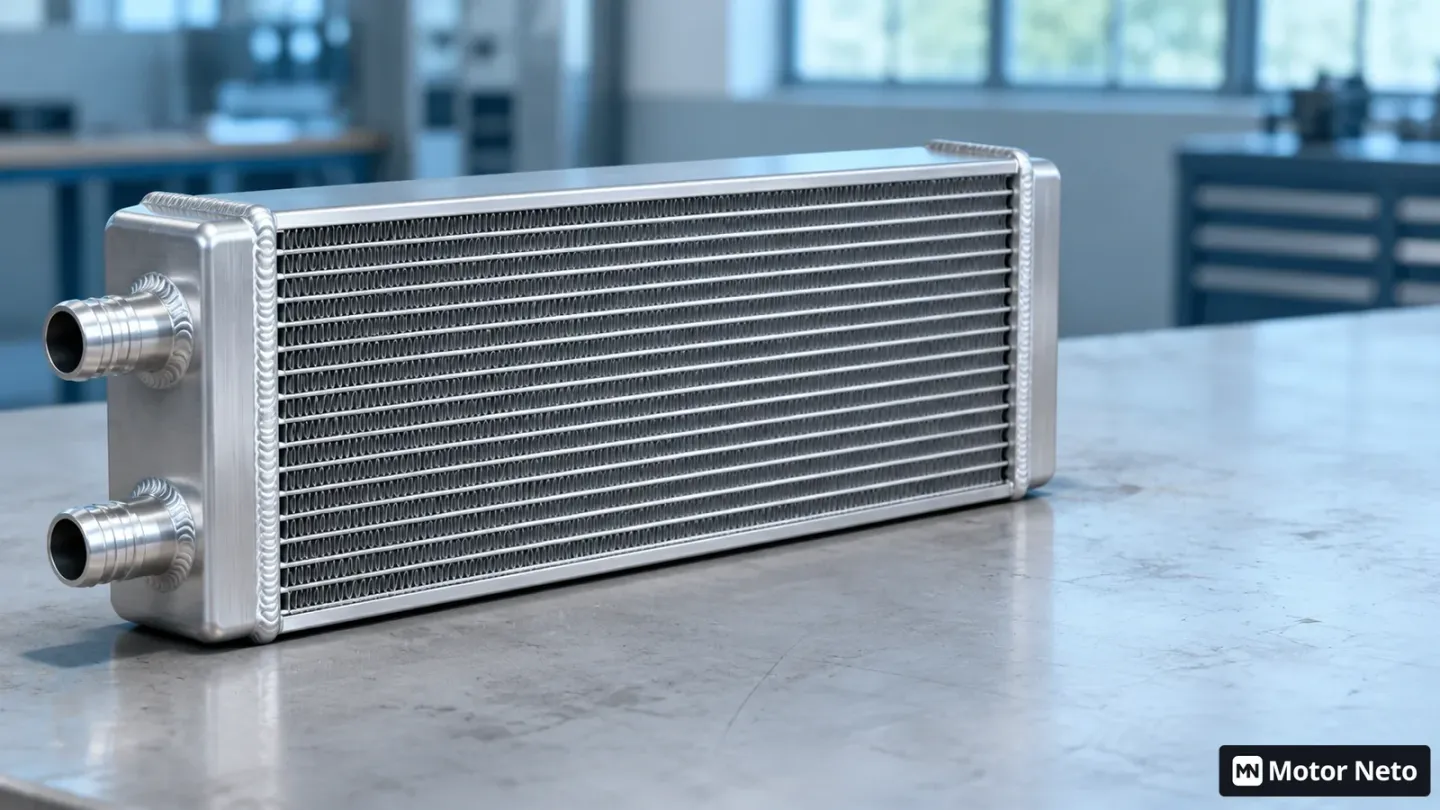
The supercharged LT4 has two different routes for shedding heat. Engine coolant travels through the engine and its radiator. In a second circuit, fluid picks up heat at the charge air cooler cores and carries it to a front exchanger. Both front components look like radiators. Only one serves the charge circuit. If the car displays an engine temperature warning, stop applying load and follow the handbook. A blower exchanger cannot fix an overheating engine.
Log ambient temperature, air temperature after the cooler, engine coolant temperature and recovery time after the lap. Note the gear and duration under load. One pull on a cool day tells little about lap four in hot weather. When hotter charge air causes the controller to reduce ignition advance, response can soften while the dashboard temperature gauge appears unchanged. Ignition correction logs help establish whether that happened.
What a double pass exchanger changes
AFCO’s 80294NDP routes coolant through two passes. DeWitts lists 32-9139007M with a larger core and tanks for 2015 to 2019. More liquid can slow the initial rise. Over a long run, the rate of transfer to the outside air determines whether temperature stabilises. Check pump circulation, trapped air and airflow through the nose before ordering. A thick core behind an obstructed opening still receives little air.
AFCO allows three to five hours
On 23 November 2026 AFCO listed $699.99 and DeWitts $741.99. At the Bank of Israel rate of 3.326 shekels per dollar on 20 November and 18% VAT on the goods, the parts alone are around 2,750 or 2,910 ₪ respectively. AFCO allows three to five hours for its product. Using the Tax Authority’s 2024 workshop benchmark of 250 to 500 ₪ an hour before VAT, the AFCO part and labour together come to about 3,600 to 5,700 ₪.
The budget excludes freight, other import charges and their VAT, fluid, diagnosis and any replacement pump. For home fitting add a vacuum filling tool if you lack one. Ask whether post-fill testing is included in the workshop quote. A car with a different blower drive ratio produces a different heat load. A catalogue figure for a standard car makes a poor comparison.
How to tell whether the installation worked
Start with the car cold and the front accessible. AFCO’s instructions specify vacuum filling equipment. The workshop drains the correct circuit, leaves clearance to adjacent cores, refills it and checks for trapped air and leaks. At home, removing air after the part is in place can be the hard part. If you cannot verify circulation, hand filling and testing to a workshop. Never open a hot, pressurised cooling circuit.
Repeat a similar load sequence and keep the log, even if the engine software is unchanged. The exchanger alone does not call for a power map. Look for quicker recovery or less charge temperature rise between runs. For a commuter who sees no such deterioration, cleaning, maintenance and a baseline measurement may be enough.
Checklist before you continue
Found an error or outdated information? Read how we handle corrections and sources, or email us: [email protected].