
The short answer
Edelbrock rates its 1570 dry sump LT1 system at 624 hp at the crankshaft. Assuming the supplied map suits the car, allow roughly 41,200 to 43,000 ₪ for kit and mechanical fitting in Israel, before freight and extras.
Who this guide is for
For Corvette C7 Stingray and Grand Sport owners comparing a supercharged LT1 with a car built around the LT4.
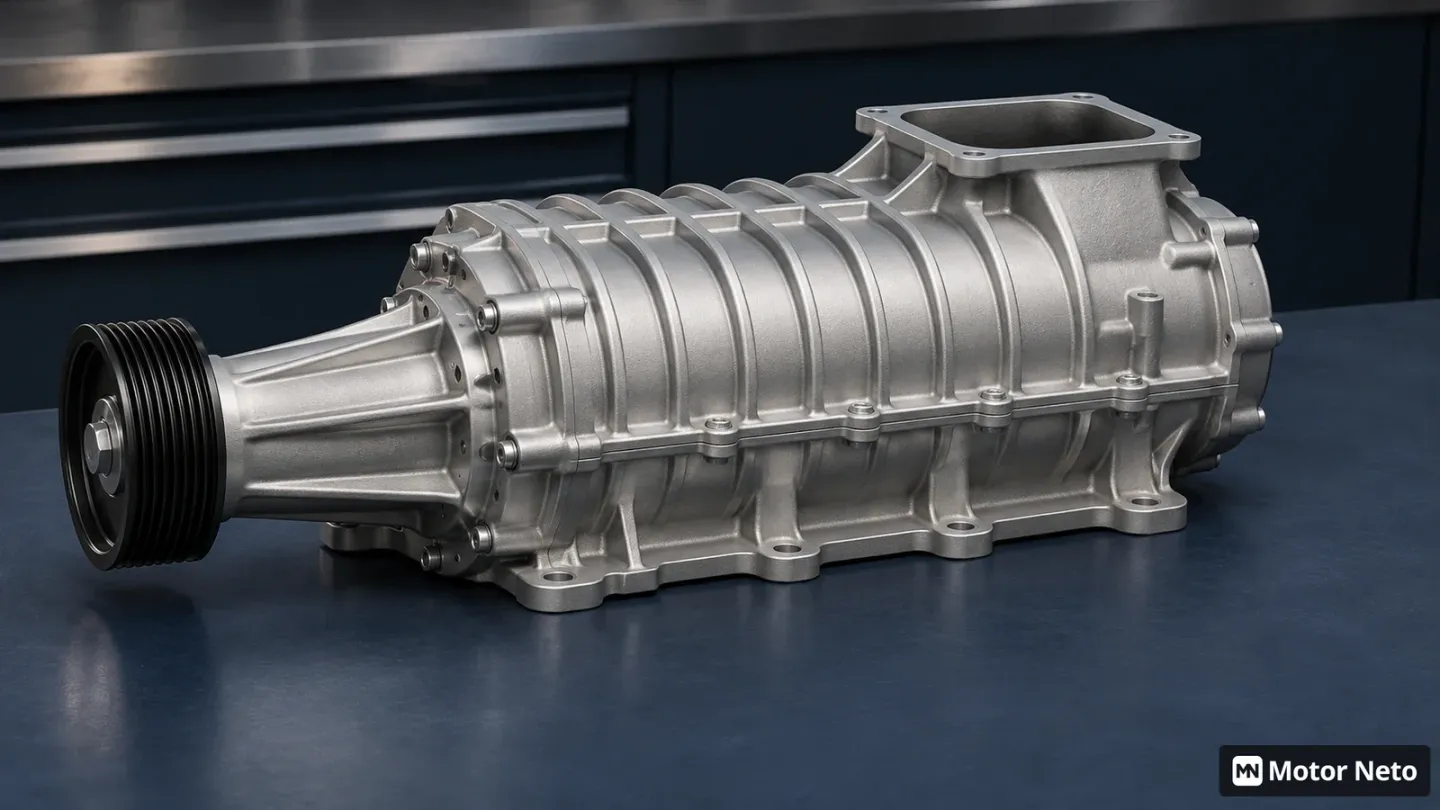
Before comparing power claims for C7 Corvette superchargers, find out where your car carries its oil. Two cars with the same 6.2 litre LT1 engine designation can have different lubrication layouts. That affects the accessory drive at the front of the engine. Edelbrock kit 1570 covers dry sump Stingray Z51 models from 2014 to 2019 and the 2017 to 2019 Grand Sport. The fitting budget below is for that configuration.
Two ways to feed the same V8
A belt takes drive from the crankshaft. A positive displacement TVS blower such as Edelbrock's sits above the engine and moves a volume of air with each rotor revolution. That makes extra torque available relatively low in the rev range. A bypass valve gives air another route when boost is unnecessary. It reduces the work the blower does at light throttle although the belt continues to turn the assembly.
With a centrifugal system such as ProCharger's for the C7, the belt drives an impeller that accelerates the air. Boost tends to build as engine speed rises. Instead of replacing the upper intake assembly, this layout needs space beside the engine and room for pipework carrying compressed and cooled air. Consider your usual gear and engine speed. Two similar peak numbers can conceal a very different amount of torque on the exit from a bend without changing down.
Crankshaft power and the distance to a Z06
Edelbrock quotes 624 hp, about 633 metric horsepower, and 600 lb-ft or roughly 813 Nm. These are total US-specification crankshaft figures. They are not a 624 hp increase. The instructions call for US petrol of at least 91 AKI, but do not identify the exact fuel for the published measurement. Have the map matched to the RON-rated petrol available in Israel.
Magnuson claims a 28% gain and 588 crank hp for its LT1 TVS2650, about 596 metric horsepower. Chevrolet rates the Z06's supercharged LT4 at 650 hp, about 659 metric horsepower. Similar-looking totals do not give a converted LT1 the internals of an LT4. Chevrolet designed the latter for higher cylinder pressures. When presented with a modified car's wheel graph alongside Chevrolet's figure, establish where each was measured first.
What comes in the crate and what determines fit
A positive displacement package contains more than rotors. Intake manifold, drive assembly, charge cooler, heat exchanger and calibration work together. Fitting under a factory bonnet also means clearing the parts on its underside. Edelbrock's instructions include work on the bonnet liner and a check that its edge clears the front water crossover. Magnuson says its system fits under the factory C7 bonnet but calls for extra drive hardware on wet sump cars. These are distinct requirements for different products.
Read the conditions attached to the supplied tune. Edelbrock specifies a standard car, allowing a cat-back exhaust. If the car already has a different Corvette C7 camshaft, establish who will calibrate that combination. The ECU must coordinate ignition and fuelling as airflow increases under load. With direct injection, check pump pressure and the time still available for injection. No single power figure determines the same fuel package for every LT1.
A budget for the dry sump car
On 23 November 2026 Edelbrock displayed a regular price of $9,995.95 for kit 1570 and marked it temporarily out of stock. At that day's Bank of Israel rate of 3.343 shekels per dollar, with 18% VAT, the kit works out at roughly 39,400 ₪. That is the home installation starting point with tools already owned and a car compatible with the supplied map. It excludes carriage for the crate, further import charges, fluids and special tools.
AmericanMuscle lists about six hours to fit this part. Using the Israel Tax Authority's 2024 garage reference of 250 to 500 ₪ per hour before VAT adds about 1,770 to 3,540 ₪. On those assumptions the kit and mechanical fitting total an estimated 41,200 to 43,000 ₪. Dyno measurement, a bespoke file for an already modified engine and clutch repairs are extra. A specialist's current hourly rate may be higher. Ask for the kit price separately from preparation and post-installation checks.
Checks to agree with the installer
Start by identifying the lubrication layout and current software, and checking for existing fuel and cooling faults. The installer can lay out the belt route and the position of the heat exchanger before final tightening. Misaligned pulleys can damage a belt. Air trapped in the cooling circuit can impair heat rejection even with a new cooler. Ask for a flow check on the separate charge cooling circuit. The engine coolant gauge alone cannot establish that it works.
A dyno applies a controlled load so the tuner can examine fuel pressure, ignition behaviour, air temperature and torque together. With an original clutch, watch for slip as mid-range torque builds. Collect the parts list, calibration ID, required fuel and the power and torque graph if ordered. A later repeat run can then be compared without guessing which map was in the car.
At home: can the car stay apart overnight?
Catalogue time is a poor allowance for a first attempt. A Grand Sport owner describing his own installation on Edelbrock's page reported 18 to 20 hours. It is one account, but explains the need for a workspace that will still be available tomorrow. You need intake and fuel system experience, torque tools, suitable removal equipment, lifting and support arrangements, and help lowering the assembly. Fuel lines can retain pressure after shutdown. Follow the kit instructions and the vehicle manufacturer's procedure.
The broad sequence covers calibration preparation, manifold removal, arranging the drive and cooling, placing the blower, and completing hoses and wiring. Check bonnet clearance, fluid filling, air removal and joint sealing before starting. If you cannot place the assembly without disturbing its seals or identify a leak, hand over to a specialist. Even a sound home installation leaves load testing and any non-standard calibration to the tuner.
Drawbacks after a successful dyno run
Peak output on one pull says little about repeated summer accelerations. The Corvette C7 Z06 cooling guide explains why charge temperature and engine coolant temperature are distinct. Boost increases driveline load and fuel demand under load. For an owner who values the character of the naturally aspirated engine or cannot leave the car off the road, the expense may outweigh the benefit. If you want a defined torque gain and can budget for cooling and testing, choose by the shape of the curve and confirmed fit.
Checklist before you continue
Found an error or outdated information? Read how we handle corrections and sources, or email us: [email protected].