
The short answer
Allow about 3,250 to 3,550 ₪ for the JLT intake, matching map, VAT and one mechanical fitting hour, before freight and additional import costs. JLT claims an extra 25 to 30 hp at the rear wheels.
Who this guide is for
For owners considering an intake change on a naturally aspirated 5.0 litre Mustang GT.
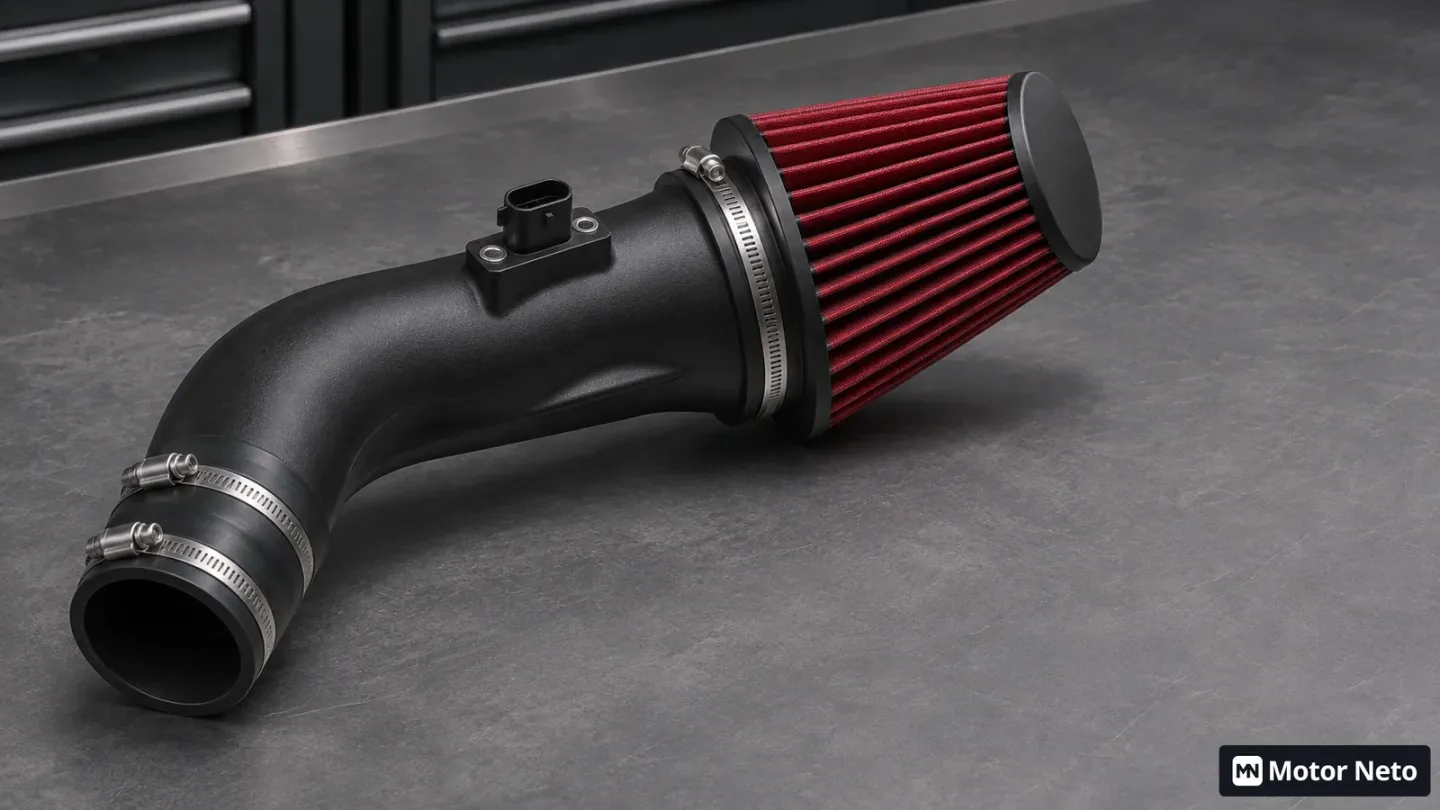
A 5.0 litre Mustang GT can take a different airbox and keep its original Ford engine software. A very similar looking pipe can use the same mounting points yet require a new calibration before the first drive. The distinction lies in the part number and the instructions for that particular kit. Neither the colour of the filter nor the size of its mouth tells you which purchase you are making. The words “cold air” on the carton do not settle it either.
What the sensor knows about the pipe
Air passes through the filter and across the mass airflow sensor on its way to the throttle. The sensor samples the flow at one point. The ECU interprets its signal using a relationship established for the shape of the original housing. Increase the cross section around the sensor and the same mass of air can pass at a different speed. The electrical signal may still be valid while the mass calculated from it is wrong. Sound wiring and a perfect seal cannot correct that mismatch.
On the 2018 to 2023 JLT intake the tube measures 120 mm at the sensor. JLT supplies a heat shield and specifies a matching tune. ROUSH engineered kit 422086 for the 2018 to 2021 GT so the sensor signal remains compatible with the factory map. Its box comes with a lid, washable dry filter, tube and fittings. Owners of a 2022 or 2023 car should match the number individually. JLT's broader fitment does not extend the application of the ROUSH kit.
How much power the claim covers
JLT quotes a gain of 25 to 30 rear wheel hp, about 25 to 30 metric horsepower when rounded. This is the manufacturer's claim for a system that requires software. Separating the pipe's contribution from the tune would take another controlled comparison. Adding the gain to Ford's published engine output would mix two measurement points. A rolling road measures what reaches the rollers after the transmission and final drive.
JLT lists US 91 and 93 AKI petrol options for its programmer. The intake page does not say which fuel produced the claimed gain. Israeli pumps carry RON numbers. Ask for written confirmation of the map for the petrol you actually buy before picking a file. ROUSH describes reduced restriction but publishes no horsepower gain on this kit's page. Louder induction under throttle is audible evidence of a different intake, not a measurement of power.
What the two routes cost in Israel
On 23 November 2026 the regular US prices were $349 for the JLT intake and another $399 for the programmer and matching file. At the Bank of Israel representative rate of 3.343 shekels per dollar that day, including 18% VAT, the two come to roughly 2,950 ₪ for a home installation with tools already owned. Freight, additional import charges, a local calibration appointment and rolling road time are outside that amount.
Steeda puts mechanical fitting at about one hour. The Israel Tax Authority's 2024 garage guide gives a typical labour rate of 250 to 500 ₪ per hour before VAT. On those assumptions the intake, programmer, file and one mechanical hour come to an estimated 3,250 to 3,550 ₪. The labour benchmark is historical. A specialist's current rate may differ. Ask whether uploading a file attracts a separate fee even if you have already paid for the file itself.
For comparison, ROUSH listed $429.99 in the US. In Israel, Super Power Parts displayed a ROUSH GT kit at 3,650 ₪, out of stock and without a part number. Use that figure as a local reference for a kit that retains the factory calibration. Ask for the exact reference and supported model years on any offer.
What the workshop measures beyond the fitting hour
Before dismantling, record the current calibration ID and establish whether a previous owner changed the software. The fitter checks connections and hoses, matches the file to the car and hardware, fits the kit, then checks for leaks and plausible sensor readings. A rolling road can apply a controlled load to examine fuelling and the power curve. To measure a change, book a baseline while the original box is in place. Match the gear, petrol and cooling conditions on the second run.
Collect an itemised parts list, calibration ID, a route back to the earlier software and the graph if you paid for a run. The Mustang EcoBoost calibration guide explains what a rolling road session adds to a supplied file. The principle of a baseline applies here too, although the files and engine targets differ.
Fitting at home: move the sensor with its seal
This is accessible work if you are familiar with engine bay connectors. Make space beside the wing for the original box and provide good lighting, sockets, an extension, screwdrivers and the Torx bit in the kit instructions. Leave time beyond the mechanical hour if the programmer is new to you. JLT's instructions put loading the map before removing the intake. Check ECU recognition and file availability while the original hardware is still in place.
Follow the instructions to release the connections, transfer sensor and seal in the specified orientation, align the shield with the air feed and connect tube and filter. A connector latched on one side or a sleeve folded under a clamp can look fine from above. Inspect the whole joint before starting. If the file will not load, leave the car where it is and contact the tuner. Checking fuelling and output under load calls for suitable measuring equipment.
The drawback can appear in stationary traffic
An exposed filter can draw warm engine bay air in a queue. Once moving, it receives air from the front. A temperature reading after a long idle tells you little on its own about an acceleration run. Check alignment with the duct and the fit of the box lid or seal. Clean reusable elements according to their type. Servicing instructions for an oiled element do not suit the dry ROUSH filter.
An intake is a manageable starting point if you want more induction sound and a measurable change on a naturally aspirated car. If a Mustang GT supercharger is already in the plan, check its parts list first. Its intake routing may replace the very pipe you are buying. Keeping the factory box costs nothing if the existing sound and response suit you, and leaves you independent of an intake-specific file.
Checklist before you continue
Found an error or outdated information? Read how we handle corrections and sources, or email us: [email protected].